Collagen Types
Multi Collagen vs. Single Collagen: The Honest Trade-Off

The tub that says "Multi Collagen: Types I, II, III, V and X" usually costs more than the one that just says "Collagen Peptides." That price gap is the whole multi collagen vs single collagen debate in miniature.
More types sounds better. Sometimes it is. But the number on the front of the tub is not the number that matters, and there is a real trade-off most brands would rather you didn't think about.
Here is how it actually works.
Single collagen means single source: one raw material, hydrolyzed into peptides. On the shelf, that is almost always bovine hide or fish skin.
The name is a little misleading. Bovine hide already delivers two types, Type I and Type III. Marine collagen is almost entirely Type I. So "single" describes the source, not a single type.
And those two are the heavy hitters. Type I is the tensile cable in your skin, tendons and bones - it alone makes up roughly 90% of the collagen in your body. Type III gives skin its give and lines your blood vessel walls.
That is why single source collagen works for a lot of people. If bovine or marine collagen covers the tissue you care about, you are covered.
Multi collagen blends several sources so each one can fill a gap the others leave.
The gaps are specific. Type II is the collagen of cartilage, and it comes from cartilage - chicken sternum and avian sternum. Cattle hide contains essentially none of it.
Types IV and V are scarcer still. Type IV forms the basement membrane that anchors the surface of your skin to the layer beneath it. Type V controls how other collagen fibers are laid down. Eggshell membrane is one of the few natural sources of both.
No single hide, fish or bird supplies all of that. That is the entire case for multi collagen: five types doing five different jobs, each drawn from a source that actually contains it.
Here is the catch. A serving is a fixed amount, and every source added to a blend shares that serving with the others.
So multi collagen gives you breadth, and single collagen gives you concentration. A scoop of plain bovine peptides puts every gram into Types I and III. A multi-source blend spreads its grams across skin, joint and membrane collagens.
That sounds like multi collagen loses on dose. For some goals it does. But the types don't work at the same scale, and that changes the math.
Type I and III peptides act largely as bulk building material - they supply the glycine, proline and hydroxyproline your fibroblasts assemble into new fibers - and research on them uses gram amounts. Some cartilage and membrane ingredients are studied at a fraction of that. Undenatured Type II collagen research uses around 40 milligrams a day. Eggshell membrane research typically uses around 500 milligrams.
A smaller share of the serving is not automatically a meaningless one. It depends on the type.
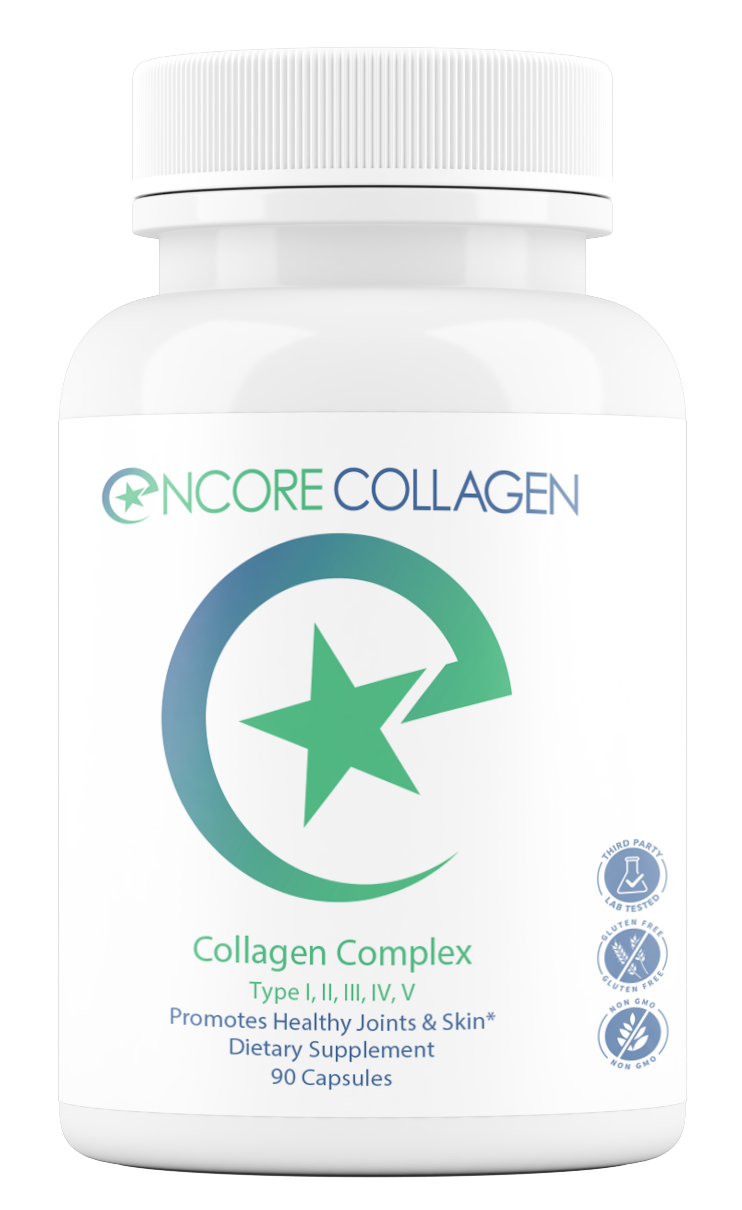
Encore Collagen Complex delivers 1,800mg from five sources - bovine, chicken, marine cod, eggshell membrane and avian sternum - so Types I through V each come from a source that contains them.
See the FormulaSkip the marketing and start with the tissue you care about.
Skin only. Types I and III do most of the work in the dermis, and a single-source bovine or marine peptide is a reasonable place to start. What it misses is Type IV, the layer that holds the surface of your skin to the dermis below.
Joints, or joints plus skin. Single source can't get you there. Cartilage runs on Type II collagen, and hide and fish don't supply it. You need a cartilage source in the mix.
Past 40 and not sure. Collagen loss runs at roughly 1% to 1.5% a year after age 25, across every tissue - not just the one you happen to notice. That is the strongest argument for coverage over concentration.
Type counts on the front of a tub are easy to inflate. Turn it around and check three things.
1. Sources, not type numbers. Every type claimed needs a source that contains it. A label promising Type II with only bovine and fish listed is a label to put back.
2. A cartilage source, if joints matter to you. Chicken collagen, chicken sternum or avian sternum cartilage. No cartilage source, no meaningful Type II.
3. Allergen notices that match the sources. Egg and fish are major allergens that must be declared. A formula with real eggshell membrane carries an egg notice. A formula with real marine collagen carries a fish notice. If a label claims those sources and shows neither warning, ask why.
Encore Collagen Complex names all five sources on the label - bovine hide, hydrolyzed chicken, marine cod, eggshell membrane and avian sternum cartilage - each matched to the collagen types it supplies, with the egg and fish allergen notice right beside them.
Single collagen is not a scam, and multi collagen is not automatically better. One gives you depth in two types. The other gives you coverage across five.
Decide which tissues you are trying to support, then check that the label's sources can actually supply them. That one habit beats any number printed on the front of the tub.
It depends on the goal. Single-source bovine or marine collagen concentrates a serving into Types I and III, the main structural collagens of skin, bone and tendon. Multi collagen spreads a serving across more sources to add Type II for cartilage and Types IV and V for membrane support and fiber organization. If you want to support joints as well as skin, a multi-source formula is the practical way to get Type II alongside Types I and III.
Bovine hide supplies Types I and III. Marine (fish) collagen is almost entirely Type I. Chicken and avian sternum cartilage supply Type II. Eggshell membrane supplies Types I, III, IV and V. No single source covers all five types, which is why complete formulas combine several.
Many people do - for example, a multi-source capsule for coverage plus a single-source powder for extra Types I and III. Follow each product's label directions, and check with your healthcare provider first if you have a medical condition or an egg or fish allergy.
1,800mg of five-source collagen per serving. Third party tested. GMP certified. 90-day money-back guarantee.
Order the Collagen Complex →