Collagen Types
The 5 Types of Collagen Peptides: What Each One Does

Hydrolyzed collagen peptides are the broken-down, bioavailable form of collagen protein — and the body uses them to rebuild all 5 types of collagen that exist in human tissue. The 5 types are I, II, III, IV, and V. Each type builds a different part of the body: Type I for skin and tendon, Type II for cartilage, Type III for the matrix around organs and blood vessels, Type IV for the dermal-epidermal junction, and Type V for hair, cornea, and placental tissue. Your body digests collagen peptides into amino acids and small peptides before it builds anything, so it is not a one-to-one swap of type for type. What the source does change is the mix: hide and fish are mostly Type I and III, cartilage sources bring Type II. A multi-source formula covers more of those sources in one serving.
Most collagen peptide supplements only contain one or two of the 5 types your body actually uses. That's a problem — because each of the five types does a completely different job.
Collagen isn't a single protein. It's a family of related proteins, each one serving a specific structural role in a different tissue. Taking a supplement with only Type I is like trying to maintain a car by only ever replacing the tires. You'll see some improvement — and miss everything else that needs attention.
Here's what each of the 5 collagen peptide types does, where it comes from, and why leaving any one out means your body gets partial coverage at best.
Best sourced from: Bovine hide collagen peptides, Marine (cod) collagen peptides
Type I is the most abundant collagen in the human body — and the most researched. It's the primary structural component of skin, bones, tendons, and ligaments. It gives skin its tensile strength: the ability to stretch and return to its original form.
By age 45, most people have lost roughly 25% of their Type I collagen from their peak. The result is thinner skin, more visible fine lines, and tendons that feel less resilient after activity.
Marine collagen peptides — sourced from fish like cod — absorb particularly quickly and efficiently, making them a premium source specifically for skin support. Bovine collagen delivers both Type I and Type III together, making it a high-value dual-purpose ingredient.
Best sourced from: Hydrolyzed chicken collagen, Avian sternum collagen
Type II collagen is the primary structural protein in cartilage — the tissue that cushions every joint in your body. It makes up approximately 50–60% of all protein in cartilage tissue.
When Type II depletes, cartilage thins. That means less cushion between joints, more friction, and the stiffness and discomfort that many people write off as "just getting older." It isn't inevitable aging. It's a deficiency.
Critically, Type II cannot be sourced from bovine collagen. This is why single-source bovine supplements consistently fall short for joint support — they simply don't contain the type your joints need. Type II is only reliably delivered through chicken and avian sternum collagen, both of which are clinically studied for cartilage and joint health.
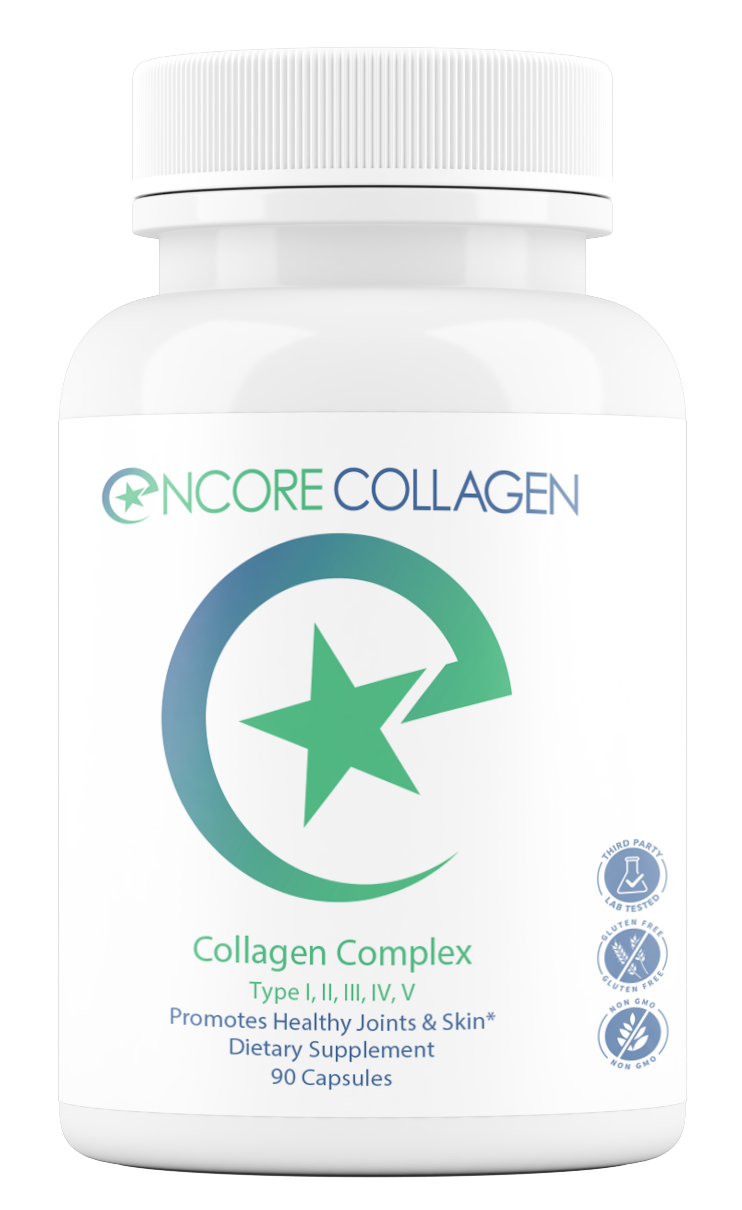
Encore Collagen Complex delivers all five collagen types — including both chicken and avian sternum for complete joint support.
Try Encore Collagen — 90-Day Guarantee →Best sourced from: Bovine collagen peptides (alongside Type I)
Type III works alongside Type I but serves a different purpose. Where Type I provides strength, Type III provides elasticity — the quality that makes younger skin spring back when pressed rather than fold and crease.
Type III also forms the structural component of blood vessel walls and supports the integrity of internal organs. Its depletion contributes to sagging skin, reduced vascular flexibility, and the loss of that firm, resilient quality most associated with youth.
Bovine collagen is the primary dietary source for both Type I and Type III, which is why it remains a cornerstone ingredient in any complete collagen formula.
Best sourced from: Eggshell membrane collagen peptides
Type IV forms the basement membrane — the thin collagen layer directly beneath the surface of your skin that separates the epidermis from the dermis. This layer is the foundation for cellular repair and regeneration. Without an intact basement membrane, cells above can't organize and rebuild properly after damage.
Type IV is found almost exclusively in eggshell membrane, which makes it one of the hardest collagen types to source and one of the most commonly missing from standard supplements. Most basic collagen products — even well-marketed ones — simply don't include it.
Best sourced from: Eggshell membrane collagen peptides (alongside Type IV)
Type V is a regulator, not a structural protein. It controls how collagen fibers organize into functional structures — acting as a template for Type I fiber assembly. Without Type V, even adequate Type I collagen can't form and organize correctly.
Think of it as the scaffold that tells all the other types where to go. Like Type IV, it's found in eggshell membrane and is almost never included in basic collagen products. Its absence means the other types you're supplementing can't be utilized as efficiently.
The collagen supplement market is dominated by single-source bovine and marine products. Both have genuine benefits — but both leave Types II, IV, and V completely unaddressed. That means your joints, cartilage, basement membrane, and collagen fiber organization continue to decline regardless of how consistently you take them.
For complete coverage, a supplement needs to source from all five: bovine, marine, chicken, eggshell membrane, and avian sternum. Each source delivers types the others can't. Together, they cover every system that depends on collagen.
Encore Collagen Complex delivers all five types from all five sources in a single 1,800mg daily serving. Third-party tested, GMP certified, made in the USA since 2006.
Keep Reading
All five types are important for different systems. Type I supports skin, bones, and tendons. Type II supports joints and cartilage. Type III supports skin elasticity and blood vessels. Type IV supports cellular repair beneath the skin's surface. Type V helps organize collagen fibers so they form correctly.
Yes — but only if the supplement sources from five different origins: bovine (Types I and III), marine fish like cod (Type I), chicken (Type II), eggshell membrane (Types I, III, IV, and V), and avian sternum (Type II). Single-source products can't deliver all five.
Clinical research supports collagen supplementation for skin hydration, elasticity, and joint function. Results typically appear after 8–12 weeks of consistent daily use. The key variable is whether the supplement delivers the right types in sufficient quantities — 1,800mg or more per serving.
Collagen production begins declining around age 25 at roughly 1.5% per year. Most people notice the effects in their 30s and 40s. Starting supplementation earlier helps preserve what you have. Starting later helps replenish what has been lost. Either way, consistent daily use is what matters most.
1,800mg of five-source collagen per serving. Third party tested. GMP certified. 90-day money-back guarantee.
Order the Collagen Complex →