Collagen Loss
How Much Collagen Have You Lost? A Breakdown by Age

If you have been feeling like your skin is thinner, your joints creak more, and your hair is not what it used to be — you are not imagining it. Collagen loss by age is a measurable, predictable decline. And the curve is steeper than most people realize.
Here is the decade-by-decade breakdown of what your body has lost — and what it means.
After age 20, collagen production drops by roughly 1% to 1.5% every single year. That is not a lifetime number. That is annual. And it compounds.
By 25, your body is already making less collagen than it did at 20. By 30, the decline is visible in your skin. By 40, it shows up in your joints. By 50, especially for women, it accelerates dramatically.
This is the top of the curve. Skin is firm, plump, and springs back instantly. Joints feel effortless. Hair is thick. Nails are strong. Collagen synthesis is at lifetime maximum around age 18-22, then begins its slow, quiet decline.
Most people in their 20s do not notice anything. The loss is happening, but the reserves are still high enough that nothing has broken down yet. This is the window where prevention matters most — and almost nobody acts on it.
By age 30, your body is producing roughly 10-15% less collagen than it did at 20. You will start noticing: fine lines around the eyes, slower recovery from workouts, nails that split more easily, hair that does not grow as fast.
The first signs are almost always cosmetic. That is because Type I collagen — the dominant type in skin, tendons, and bones — declines fastest in the visible areas first. Joint comfort is usually still fine. Skin is where the 30s show up.
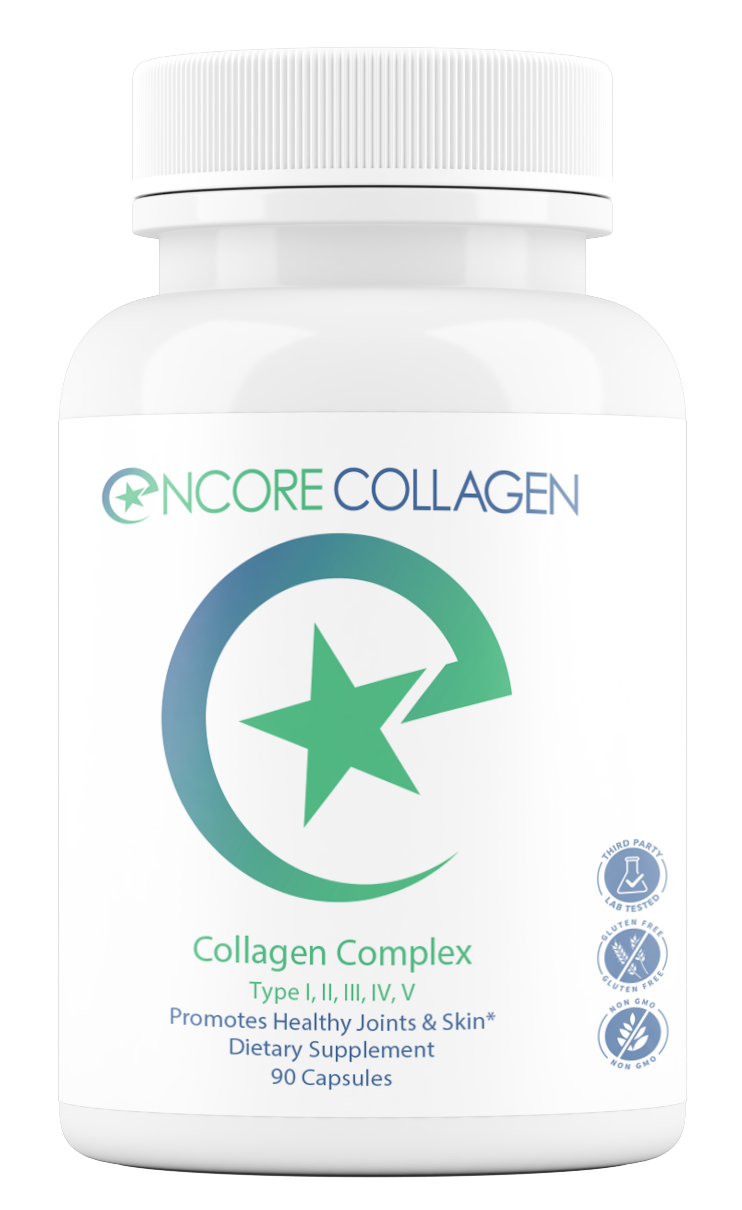
Most collagen supplements only provide Type I and III. Encore Collagen Complex includes all five types from five different sources — exactly what your body stops making after 30.
See the Formula →For women, the 40s bring a second hit. Starting in the late 30s and accelerating through perimenopause, estrogen begins to drop — and estrogen is one of the main signals that tells fibroblasts to make collagen.
The result: in the first five years after menopause, women lose up to 30% of their remaining skin collagen. That is roughly a decade worth of loss compressed into five years. It is why skin changes often feel abrupt rather than gradual.
Men experience a slower, steadier decline in their 40s — no menopause cliff, but testosterone drops and protein synthesis slows. Joint stiffness and slower recovery from exercise typically start showing up here.
By age 60, most people have lost roughly 50% of the collagen they had at age 20. This is not just a cosmetic number. It is structural. Cartilage in knees, hips, and shoulders thins. Tendons lose elasticity. Skin loses its dermal scaffolding. Blood vessel walls weaken.
Type II collagen — the cartilage collagen — becomes especially critical in this stage. Joint pain, stiffness, and reduced range of motion are almost always partly a collagen issue by this age.
Collagen loss is not just about looking older. It is about every tissue that depends on collagen as its structural protein — which is nearly every tissue in your body. Skin, bones, joints, ligaments, tendons, blood vessels, gut lining, hair, nails.
The good news: while you cannot reverse the clock, you can reduce the rate of loss and give your body the raw materials to repair what is still being broken down. Studies on hydrolyzed collagen supplementation show measurable improvements in skin elasticity, joint comfort, and hair thickness — especially in adults over 40, where the baseline is lowest.
Encore Collagen Complex delivers 1,800mg of Types I–V collagen from five sources, in the forms your body is losing fastest after 30. One scoop a day, mixed into anything.
You have lost more collagen than you think. By 30, about 10-15%. By 50, roughly a third. By 60, half. The decline is invisible for years, then suddenly visible everywhere at once.
The best time to start replacing what you have lost was your late 20s. The second best time is today.
Keep Reading
Collagen production begins to decline slowly in your mid-20s, at roughly 1% to 1.5% per year. By age 30, the decline is visible in skin; by 40, it often shows up in joints. Women experience an acceleration during perimenopause and the first five years after menopause, when estrogen drops sharply.
By age 50, most people have lost roughly 30% to 40% of the collagen they had at age 20. For women, the post-menopause drop accelerates this further - an additional 30% loss in skin collagen can occur in the first five years after menopause.
You cannot reverse the overall age-related decline, but you can reduce the rate of loss and support repair. Studies on hydrolyzed collagen supplementation show measurable improvements in skin elasticity, joint comfort, hair thickness, and nail strength - with the most dramatic effects in adults over 40, where baseline collagen is lowest.
1,800mg of five-source collagen per serving. Third party tested. GMP certified. 90-day money-back guarantee.
Order the Collagen Complex →