Joint Health
Lower Back Pain: The Collagen Type Most Supplements Skip
You are taller right now than you will be tonight.
Not by much - roughly half an inch for most adults - but it is measurable, and it happens every single day. Overnight, with the weight of your upper body off your spine, your intervertebral discs pull water back in and swell. By evening, hours of standing and sitting have squeezed a portion of it back out.
That daily rise and fall is the clearest window you have into what your lower back is actually made of. Because the thing doing the swelling is not muscle. It is collagen.
Each disc between your vertebrae has two distinct parts, and they are built from different materials.
The outer ring, the annulus fibrosus, is dense Type I collagen laid down in fifteen to twenty concentric layers. Each layer runs at roughly a thirty-degree angle, and adjacent layers cross in opposite directions - the same trick a steel-belted radial tire uses to resist twisting in every direction at once.
The inner core, the nucleus pulposus, is a different structure entirely. It is a loose mesh of Type II collagen holding a gel of proteoglycans, and those proteoglycans are what bind water. In a healthy young disc, that core is close to 85% water. It behaves like a hydraulic cushion: press on it and pressure distributes evenly in all directions.
Type I is the cable. Type II holds the water. You need both, and they fail in different ways.
Discs have almost no blood supply. After your mid-twenties they are the largest avascular structures in the human body, fed only by fluid diffusing in through the bone endplates above and below.
That has a consequence most people never hear: repair is slow. Collagen turnover in a spinal disc is measured in decades, not weeks. So the roughly 1% to 1.5% you lose every year after 25 is not being briskly replaced the way it is in skin.
What changes first is the water. As proteoglycan content falls, the core dries from about 85% water toward roughly 70%. A drier core is a shorter core, and a shorter core is a stiffer segment. The disc stops behaving like a hydraulic cushion and starts behaving like a shock absorber with the fluid drained out.
This is why the first sign is almost never sharp - it is morning stiffness that loosens after twenty minutes of moving. You are feeling a disc that rehydrated less overnight than it used to.
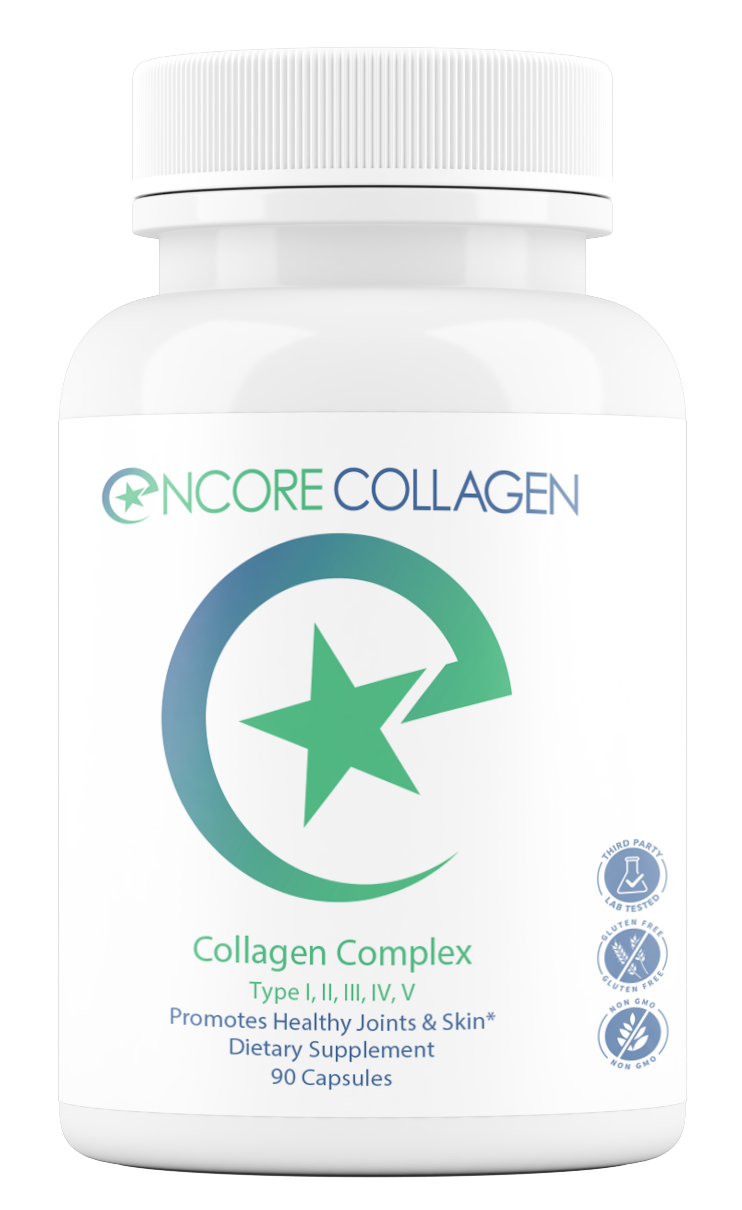
Encore Collagen Complex delivers 1,800mg of Types I through V from five sources - covering the cable, the cushion, and the connective tissue in one formula.
See the FormulaHere is the part that connects disc structure to the joints people actually notice.
When a disc loses height, the vertebrae above and below sit closer together. That shifts load onto the facet joints - the small paired joints at the back of every spinal segment that guide how you bend and twist.
Facet joints are lined with hyaline cartilage. Hyaline cartilage is Type II collagen. So a Type II change in the disc core quietly creates a second Type II demand one structure over, and the facets were never built to carry that share of the load. It is the same cascade that shows up in the hips and the knees, just stacked vertically.
Meanwhile the ligaments running the length of your spine - the anterior and posterior longitudinal ligaments, the ligamentum flavum - are dense Type I collagen cable. As they lose tensile quality, the segment gets less precisely controlled, and the muscles around it work harder to compensate. That compensating is what most people mistake for the original problem.
Now put that against what is actually in most collagen supplements.
The standard bovine hide powder on the shelf is roughly 90% Types I and III. Those are real and useful - Type I is your annulus, your ligaments, and the organic scaffold of the vertebrae themselves. But the disc core is Type II. The facet cartilage is Type II. The endplate cartilage is Type II.
Cattle hide contains essentially none of it. Type II comes from cartilage sources - chicken sternum, avian collagen, eggshell membrane - which is why a single-source powder covers the outer half of the structure and misses the middle.
Hydrolyzed peptides help on both fronts. They supply glycine, proline and hydroxyproline, the three amino acids the collagen triple helix is built from, and the peptide fragments themselves signal to fibroblasts and chondrocytes that building is needed. But signal and raw material only matter where the right type is present to build with.
This is the reason Encore Collagen Complex is built from five sources rather than one - bovine, chicken, marine cod, eggshell membrane, and avian sternum - so Types I through V are all represented instead of just the two that come from hide.
Spinal collagen turns over slowly, so this is not a two-week story. Joint and connective tissue research generally runs 90 to 180 days before differences separate out, and the discs are the slowest tissue in the group.
The realistic goal is not reversal. It is slowing a decline that is otherwise running at 1% to 1.5% a year, every year, in a structure that cannot easily repair itself. Consistency beats timing - the hour you take it matters far less than the streak.
Your lower back is a stack of collagen structures doing a mechanical job. Give it the full set of building blocks, and give it long enough to use them.
Collagen is a structural protein, not a treatment. What it does is supply the amino acids and peptide signals your body uses to maintain the discs, cartilage, and ligaments that make up the spine. Supporting that structure is the mechanism - individual results vary, and persistent or severe back pain should be evaluated by a healthcare professional.
Both. The outer ring of the disc (the annulus fibrosus) is primarily Type I collagen arranged in crossing concentric layers. The inner gel core (the nucleus pulposus) is primarily Type II collagen holding water-binding proteoglycans. The facet joints and bone endplates are Type II as well, which is why single-source bovine collagen - mostly Types I and III - covers only part of the structure.
Longer than skin. Studies on joint and connective tissue typically run 90 to 180 days, and spinal discs turn over more slowly than any other collagen structure in the body because they have almost no blood supply. Plan in months, and prioritize taking it consistently over taking it at a particular time of day.
1,800mg of five-source collagen per serving. Third party tested. GMP certified. 90-day money-back guarantee.
Order the Collagen Complex →