Collagen Types
Complete Collagen Complex: What the Label Should Tell You

"Complete" is one of the most common words on a collagen bottle, and one of the least defined. No regulation says what a complete collagen complex has to contain, so any brand can print it. That does not make the word meaningless. It means the label has to back it up, and you need to know what to look for.
Here is a practical way to read one, check by check.
Your body makes at least 28 types of collagen, but five do most of the work. Type I runs through skin, bone and tendon. Type II is the backbone of cartilage. Type III sits alongside Type I in skin and blood vessels. Types IV and V are smaller players that build membranes and organize fibers. Our guide to the 5 types of collagen covers each one in detail.
A fair definition of a complete collagen complex is one that draws on sources covering those major types, especially the cartilage side (Type II) that skin-focused products usually leave out.
One honest caveat: once collagen is hydrolyzed, digestion breaks it into peptides and amino acids. The type number really tells you which tissue the raw material came from, and that shapes the peptide mix you absorb. It is a useful signal, not a guarantee of where the collagen ends up.
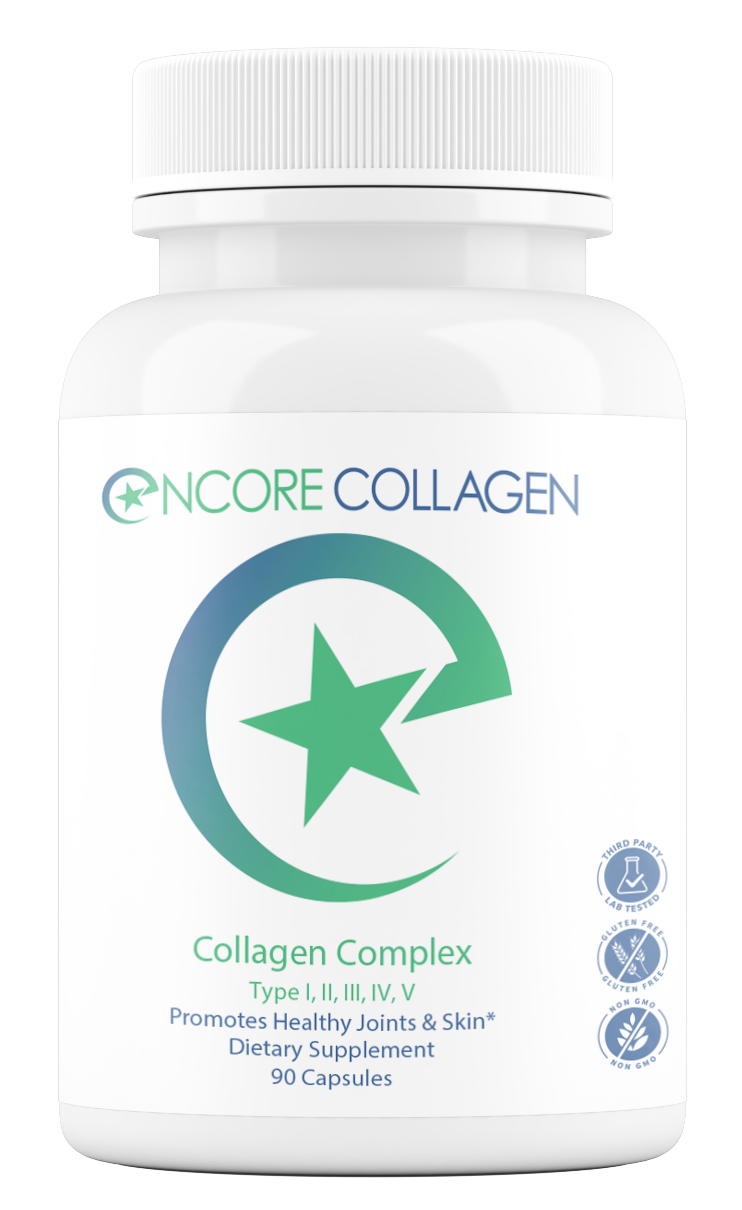
Encore Collagen Complex draws on five sources - bovine hide, chicken cartilage, wild-caught cod, eggshell membrane and avian sternum - to cover Types I through V in one three-capsule serving.
See the Formula1. Look for sources, not just type numbers. Collagen types come from specific tissues. Hide and fish skin are rich in Types I and III. Cartilage and sternum supply Type II. Eggshell membrane brings a mix of collagen types along with other matrix proteins. If a label claims Type II but lists no cartilage source, ask where it comes from.
2. Check the form. Most collagen is hydrolyzed, which means it has been broken into small peptides that absorb well. That is the form behind most skin and joint studies (more in our hydrolyzed collagen guide). Undenatured Type II, often sold as UC-II, is a different ingredient. It is taken in tiny doses and studied for a different mechanism. Neither is wrong, but they are not interchangeable, so a label should say which one you are getting.
3. Note what comes with it. Many complexes add glucosamine, chondroitin or hyaluronic acid. These are not collagen, but they are part of the same cartilage and joint-fluid system. They are not required for a product to be complete, but they matter if joint support is your main goal.
4. Read the allergen line. The more sources a complex uses, the more likely it contains fish or egg. If you avoid either, check before you buy. Our breakdown of marine vs bovine collagen covers the source differences.
Most clinical research tests hydrolyzed collagen as a category, not one exact blend against another. The studies that show modest improvements in skin elasticity and joint comfort generally ran eight to twelve weeks or longer, with people taking it every day.
So consistency matters more than any single label claim. A good complex taken daily for three months will tell you more than a perfect label taken now and then. Your body also needs vitamin C to build collagen, so a diet with fruit and vegetables does part of the work.
A single-source collagen is not a bad product. It just covers less ground. If you are weighing the two, our multi vs single collagen comparison lays out the trade-off honestly.
How Encore reads on these four checks: five named sources, hydrolyzed collagen covering Types I through V, glucosamine, chondroitin and hyaluronic acid in the same serving, and a clear allergen statement (contains fish and egg).
The bottom line: "complete" is a claim, not a standard. A complete collagen complex earns the word when its label shows sources for the major types, tells you the form, and is upfront about what else is inside. Then take it daily and give it time.
A complete collagen complex is a supplement that combines several collagen sources to cover the major collagen types, usually Types I, II and III and often IV and V. The term is not regulated, so check that the label names a source for each type it claims.
No. Types I and III are the most abundant in skin, and Type II is the main collagen in cartilage. A product with all five covers more tissues, while a single-source product can still be useful for a specific goal. Hydrolyzed collagen is broken into peptides during digestion either way.
They do different jobs. Hydrolyzed collagen is broken into small peptides and is the form used in most skin and joint studies. Undenatured Type II is taken in very small doses and studied for a different mechanism. A label should state which form it contains.
1,800mg of five-source collagen per serving. Third party tested. GMP certified. 90-day money-back guarantee.
Order the Collagen Complex →