Why Collagen
Collagen and Inflammation: What the Research Says

Most people ask about collagen and inflammation backwards. They want to know whether collagen calms inflammation. The more useful question is the other one: what inflammation is doing to the collagen you already have.
Because that part is not in dispute. Chronic, low-grade inflammation is one of the fastest ways to lose structural protein - and it works quietly, for years, without a single symptom you would name as inflammation.
Your body is always tearing down old collagen and laying in new. The demolition crew is a family of enzymes called matrix metalloproteinases, or MMPs. MMP-1 is the specialist - it is the enzyme that cuts the triple helix of Type I collagen apart.
Inflammatory signaling turns that crew up. Cytokines like IL-1 beta and TNF-alpha push fibroblasts to make more MMPs, and the same signaling suppresses new collagen synthesis at the same time. Output down, teardown up.
Researchers gave the slow version of this a name: inflammaging. It describes the low-grade inflammatory tone that builds with age, driven by visceral fat, poor sleep, high blood sugar, smoking and sedentary time. It sits well below the level that makes you feel sick, and it runs for decades.
That is why the number matters. Collagen production already falls by roughly 1% a year after your mid-twenties. Sustained inflammation raises the demolition rate on top of it. UV exposure works the same way - it is an inflammatory hit that drives MMP-1 through the roof in skin.
Here is the part of the collagen and inflammation story that has real mechanism behind it, and it comes down to a single amino acid.
Collagen is about one-third glycine. Every third position in the helix is glycine - no other dietary protein is remotely that concentrated in it. When you take hydrolyzed collagen, glycine is what you are getting more of than anything else.
Glycine is not only a building block. Immune cells - macrophages and neutrophils among them - carry glycine-gated chloride channels. In cell and animal studies, glycine binding at those channels hyperpolarizes the cell and blunts the calcium signaling that drives inflammatory cytokine release. It is a documented immunomodulatory pathway, not marketing.
Glycine is also one of three amino acids your body assembles into glutathione, its main internal antioxidant, and glycine supply is often the limiting step. Typical Western diets run low on it.
That said, the honest framing matters: most of this evidence comes from laboratory and animal work using isolated glycine, not from human trials of collagen supplements. The mechanism is real. The size of the effect from a daily capsule in a human being is not established.
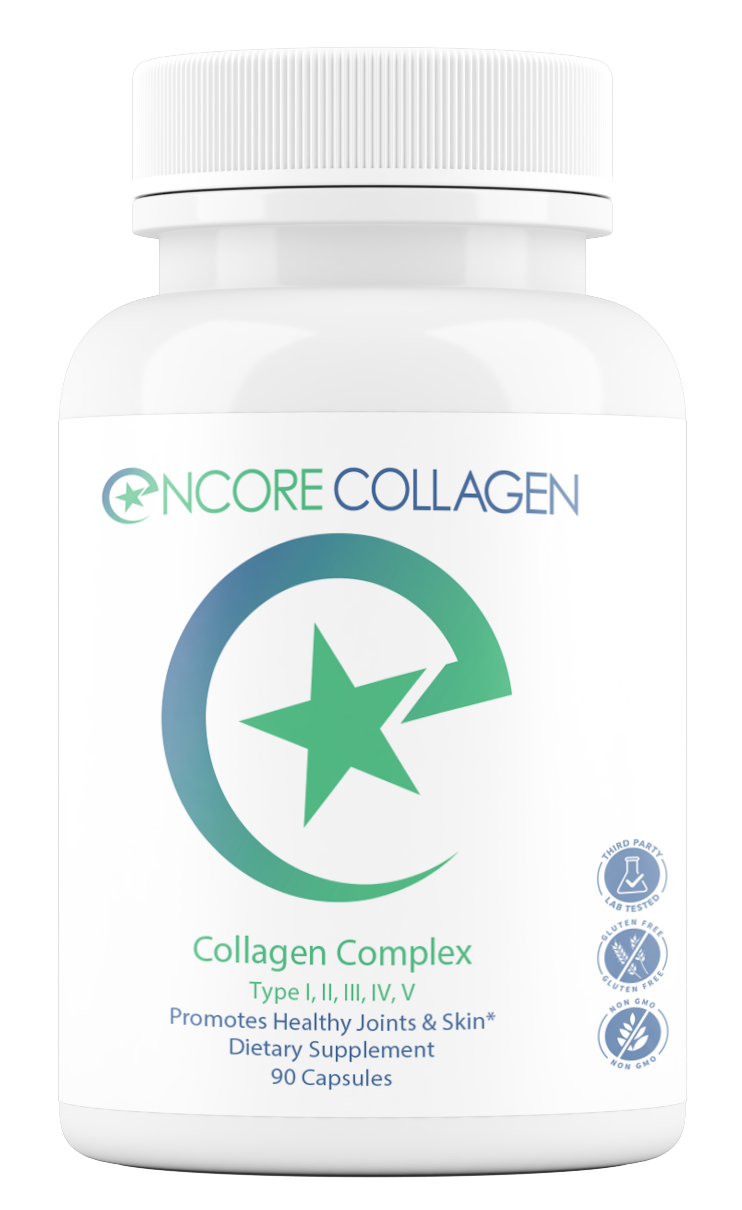
Encore Collagen Complex delivers 1,800 mg of hydrolyzed collagen across five sources - so the glycine, proline and hydroxyproline your fibroblasts draw on are there when rebuilding demand is high.
See the FormulaSplit the evidence into two piles, because they are not equally strong.
Joint comfort and function: reasonably consistent. In a 24-week trial of 147 athletes, 10 grams of collagen hydrolysate daily produced less joint pain during activity than placebo. A later trial in young adults with activity-related knee pain reported the same direction at 5 grams over 12 weeks. A separate line of work on undenatured Type II collagen - 40 mg daily, a different mechanism working through immune tolerance in the gut - reported improved WOMAC scores in knee osteoarthritis over 180 days.
Blood markers of inflammation: mixed. Some collagen peptide trials report lower C-reactive protein or improved oxidative stress markers. Others find no significant change. The trials are small, the populations differ, and the doses and sources vary widely. Anyone quoting this pile as settled is overselling it.
Notice what the stronger pile measures. Those trials tracked how joints felt and functioned - not inflammation itself. Better cartilage substrate supply and less inflammatory signaling can both produce that result, and the studies were not designed to separate them.
Collagen is not an anti-inflammatory. It is not a substitute for one, and it does nothing on the timescale that an NSAID does.
What it plausibly does is support the rebuild side of the equation while you deal with the demolition side somewhere else. If inflammation is running hot, the drivers are the leverage: sleep, visceral fat, blood sugar, alcohol, smoking, sun exposure and how much you move. Those move inflammatory tone far more than any capsule.
Supplement side, keep it simple. Use a hydrolyzed form so absorption is not the bottleneck, take it daily, and give it eight to twelve weeks - that is the window where the skin and joint trials report changes. If you have diagnosed inflammatory arthritis or an autoimmune condition, talk to your doctor before adding anything.
Encore Collagen Complex uses bovine hide, chicken sternum, wild-caught cod, eggshell membrane and avian sternum cartilage to cover Types I through V, with glucosamine, chondroitin and hyaluronic acid alongside them.
The takeaway is a rate problem, not a miracle. Inflammation speeds up the teardown of your collagen. You lower the teardown with how you live, and you supply the rebuild with what you eat. Both sides of that equation are yours to move.
The evidence is mixed. Some collagen peptide trials report lower C-reactive protein and better oxidative stress markers, while others find no change. Glycine, which makes up about a third of collagen, has a documented immunomodulatory pathway in laboratory research, but that has not been confirmed as a meaningful effect from collagen supplements in humans. Collagen is not an anti-inflammatory medication and should not replace one.
Yes, and this direction of the relationship is far better established. Inflammatory cytokines increase matrix metalloproteinases, the enzymes that break collagen down, while simultaneously suppressing new collagen synthesis. Chronic low-grade inflammation from poor sleep, visceral fat, high blood sugar, smoking and UV exposure accelerates collagen loss on top of the roughly 1% a year that happens with age anyway.
Trials that report changes in joint comfort or skin elasticity typically run eight to twenty-four weeks of daily use. Nothing in this research shows a short-term effect, so consistency over a couple of months matters far more than the dose on any single day.
1,800mg of five-source collagen per serving. Third party tested. GMP certified. 90-day money-back guarantee.
Order the Collagen Complex →