Skin Health
Sun Damage and Collagen: How UV Accelerates the Decline

Every summer the same conversation shows up in dermatology clinics: someone in their forties walks in convinced the wrinkles appeared overnight. They didn't. They were being built underneath the skin for the last twenty summers, one afternoon at a time.
The mechanism is called photoaging, and the target is your collagen.
UV light doesn't just brown the top layer of your skin. UVA in particular penetrates all the way down into the dermis — the layer where collagen and elastin form the scaffolding that holds skin firm and smooth.
Once UVA reaches the dermis, it triggers a group of enzymes called matrix metalloproteinases (MMPs), especially MMP-1 and MMP-3. These enzymes exist for good reason — they help remodel tissue during normal healing — but UV switches them on at levels the body isn't equipped to counterbalance. MMPs then chew through mature collagen fibers faster than fibroblasts can rebuild them.
Type I collagen, which makes up roughly 80 percent of skin's dermal structure, is the biggest casualty. Type III, its elasticity partner, is degraded right alongside it. Over years, the net effect is a thinner dermis, disorganized fibers, and the visible sagging and creasing we call "sun damage."
Estimates from photoaging research suggest that up to 80 to 90 percent of visible facial aging is caused by UV exposure — not chronological age. That's why the underside of your forearm at 55 usually looks decades younger than the top of your hand at the same age. Same person. Same year of birth. Wildly different UV history.
The body's natural collagen production is already slowing by about 1 to 1.5 percent per year after 25. Add cumulative UV exposure on top of that and the decline curve gets much steeper — which is why photoaged skin often looks a full decade ahead of its chronological age.
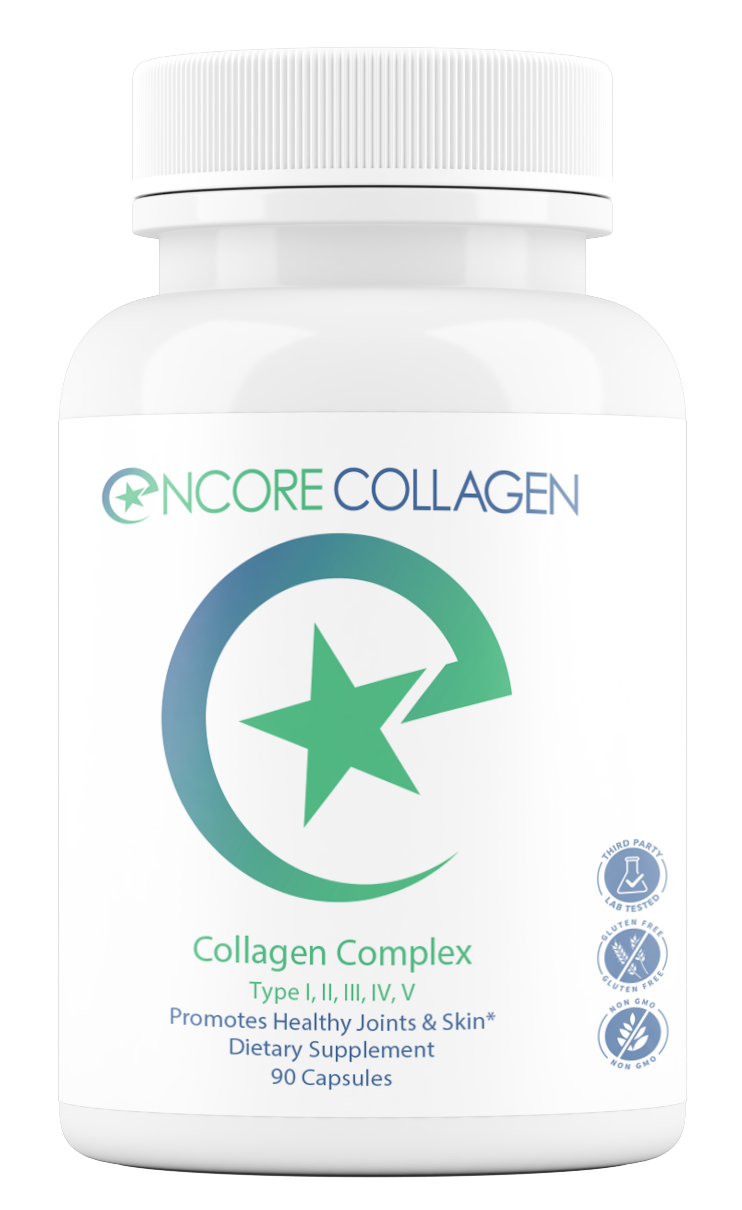
Encore Collagen Complex delivers 1,800mg of Types I, II, III, IV and V from five natural sources — the same collagen types UV rays break down in the dermis. Third-party tested, GMP certified.
Try Encore Collagen →1. Direct MMP activation. As covered above — UVA switches on enzymes that shred existing collagen fibers.
2. Free radical damage. UV exposure floods the dermis with reactive oxygen species. These free radicals damage the fibroblast cells that produce collagen in the first place — meaning less collagen output, not just faster breakdown.
3. Cross-link disruption. Healthy collagen fibers are held in an organized, cross-linked matrix. UV creates abnormal cross-links and disorganized fiber bundles — the biochemical signature of photoaged skin under a microscope looks visibly tangled compared to sun-protected skin.
The unglamorous truth first: broad-spectrum sunscreen is still the single most effective anti-aging tool that exists. Daily SPF 30+ blocks the majority of UV before it ever reaches the dermis. No supplement replaces this step.
But sunscreen has ceilings. Even SPF 50 lets roughly 2 percent of UVB through, and UVA passes through car windows, cloud cover, and any patch of skin you forgot to cover. That's where supporting your body's own collagen supply matters.
Human trials on hydrolyzed collagen peptides consistently show improvements in skin elasticity, hydration, and dermal density over 8 to 12 weeks. The mechanism is simple: peptides deliver the specific amino acid building blocks (glycine, proline, hydroxyproline) that fibroblasts need to build new collagen. When UV degrades old fibers, the body has the raw materials to replace them faster.
A multi-type formula matters here. UV damages Type I and Type III together, and both need to be rebuilt. Encore Collagen Complex provides all five types — including the Type IV that anchors the dermis to the epidermis and takes some of the earliest UV damage.
Nothing exotic. The evidence points the same direction every time:
Broad-spectrum SPF 30+ every morning, reapplied if you're outside. A collagen peptide supplement daily to replenish raw materials. Vitamin C — either topical or dietary — because fibroblasts can't build collagen without it. And enough sleep, because collagen synthesis peaks during deep sleep and gets short-changed when you don't.
None of these are new. What's new is understanding why they work together: SPF reduces the damage input, collagen supplies the repair materials, vitamin C enables synthesis, and sleep gives the body the window to actually do the work.
Sun damage isn't cosmetic — it's structural. UV directly activates the enzymes that break down your Type I and Type III collagen, and it does it faster than your body naturally rebuilds. That's why photoaged skin looks a decade older than the calendar says.
You can't undo the UV your skin has already absorbed. But you can slow what happens next: block the input with SPF, and give your body the raw materials to rebuild what UV keeps breaking down.
Sunscreen blocks a large portion of incoming UV, but no product stops 100 percent. Even SPF 50 lets through roughly 2 percent of UVB, and UVA penetration through windows and clouds is often underestimated. Sunscreen is essential, but supporting your body's collagen production adds a second line of defense.
They can't erase deep photoaging, but human trials show hydrolyzed collagen peptides improve skin elasticity, hydration, and dermal density over 8 to 12 weeks. That's the same layer UV rays degrade. Combined with daily SPF, collagen supplementation gives the skin the raw materials to repair what it can.
Type I collagen makes up around 80 percent of skin's dermal structure, and it is the primary target of UV-triggered enzymes called MMPs. Type III, the elasticity partner, is degraded alongside it. A multi-type collagen supplement covers both.
1,800mg of five-source collagen per serving. Third party tested. GMP certified. 90-day money-back guarantee.
Order the Collagen Complex →