Collagen Loss
Collagen Depletion Symptoms: 7 Signs Your Body Is Running Low
Nobody wakes up one morning and notices their collagen is gone. It leaves the way a roof fails - quietly, from the inside, years before anything visibly caves in.
That is what makes collagen depletion symptoms so easy to misfile. Stiff fingers get blamed on the weather. Splitting nails get blamed on dish soap. Thinning hair gets blamed on stress. Each one looks like an isolated annoyance. Together, they are a pattern.
Collagen is roughly 30% of the protein in your body and the structural material behind skin, cartilage, tendons, ligaments, blood vessels, hair follicles, and nail beds. Production starts declining in your mid-twenties at about 1% to 1.5% a year, and the tissues that turn over slowest feel it first.
1. Morning stiffness that loosens once you move. Cartilage is mostly Type II collagen and water. As that matrix thins, joints lose the cushioning that keeps movement smooth, and the first ten minutes of the day get noticeably rough. If it shows up in your fingers first, that is a specific and well-documented pattern.
2. Nails that split and peel before they grow. The nail plate is built on a collagen-rich bed. When that foundation weakens, nails stop growing thick and start growing in layers that separate. Brittle nails are one of the earliest visible signals, because nails grow fast enough to show a supply problem quickly.
3. Hair thinning at the part rather than the hairline. Collagen forms the connective sheath around each follicle and makes up much of the dermal papilla that feeds it. Diffuse thinning across the top - as opposed to a receding front - is the signature of a follicle support problem, not a hormonal recession pattern.
4. Skin that stays tented when you pinch it. Pinch the back of your hand and let go. Skin with intact Type I and Type III collagen snaps flat almost instantly. Skin that holds the fold for a beat has lost elastic recoil. This is the closest thing to an at-home collagen test, and it costs nothing.
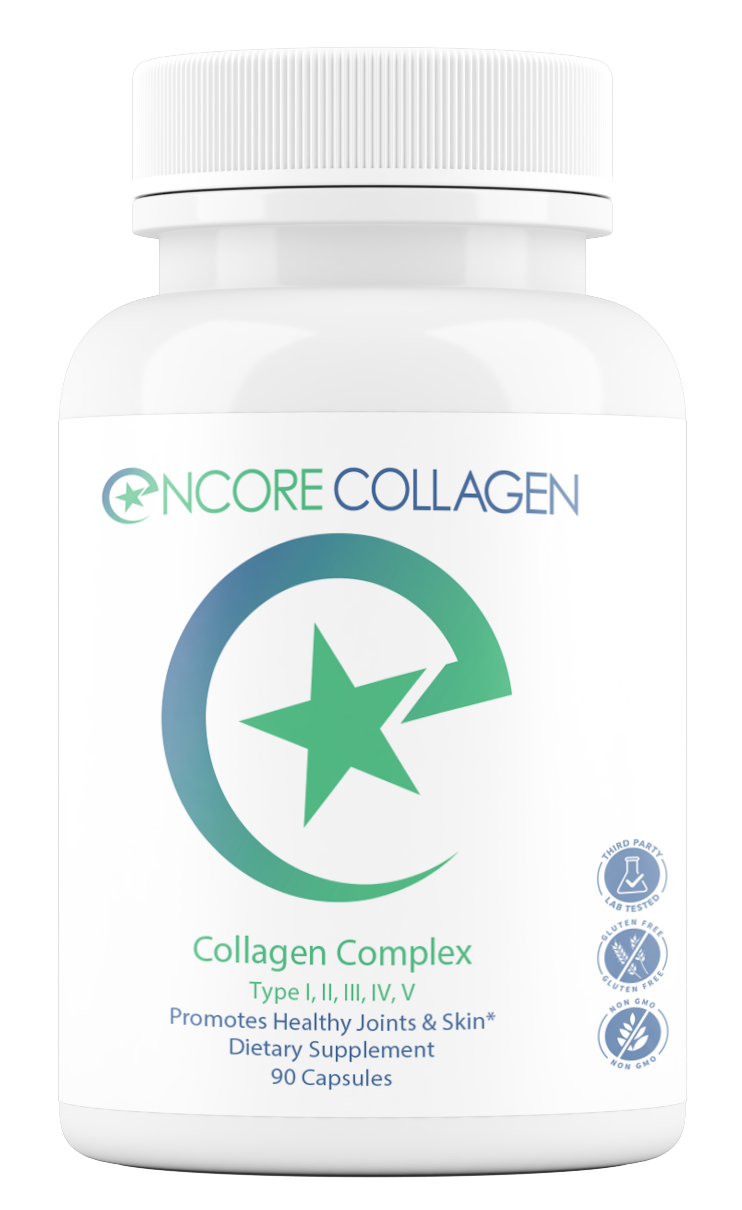
Encore Collagen Complex delivers 1,800mg of Types I through V from five sources - covering skin, joints, hair, nails, and connective tissue in one formula.
See the Formula5. Cuts and scrapes that take longer to close. Wound repair is collagen work from start to finish. Fibroblasts lay down Type III collagen to bridge the gap, then remodel it into stronger Type I over the following weeks. Less raw material means a slower timeline and a thinner final result.
6. Aching after activity you used to handle fine. Tendons and ligaments are dense collagen cable. As the cable frays, the same mileage, the same stairs, and the same weekend project produce more soreness and take longer to recover from. People usually call this getting older. Structurally, it is getting thinner.
7. Crepey texture on the neck, chest, and backs of the hands. These areas have less oil, less fat padding, and more sun exposure than the face, so declining Type IV collagen at the dermal-epidermal junction shows up there first. Fine crinkling that appears without deep wrinkles is a scaffolding issue, not a hydration one.
The 1% to 1.5% annual decline is the baseline, and almost nobody stays on baseline.
UV exposure triggers enzymes that break collagen down faster than it is replaced. Sugar binds to collagen fibers and stiffens them through glycation. Smoking suppresses fibroblast activity outright. And in women, the drop in estrogen around menopause can cost up to 30% of skin collagen in the first five years alone.
That is why two people the same age can be a decade apart structurally. Age sets the rate. Everything else sets the multiplier. The breakdown by decade makes the curve easy to see.
Your body does not run out of the ability to make collagen. Production slows, but fibroblasts keep working for your entire life - they just get less raw material and fewer signals telling them to build.
Hydrolyzed collagen peptides address both. They deliver glycine, proline, and hydroxyproline, the three amino acids the collagen triple helix is built from, and the peptide fragments themselves act as a signal to fibroblasts that repair is needed.
The catch is coverage. Symptoms on this list span at least four different collagen types - Type I in skin and bone, Type II in cartilage, Type III in blood vessels and early wound repair, Type IV in the membrane under your skin. A single-source bovine powder is mostly Types I and III. That leaves the joint and junction symptoms unaddressed.
Encore Collagen Complex spans all five collagen types from five sources - bovine, chicken, marine cod, eggshell membrane, and avian sternum - so the full range of tissues has something to draw on.
One of these signs on its own means very little. Three or four of them at once, in a body past its mid-thirties, is not a coincidence - it is a supply problem with a name. And unlike most things that arrive with age, this one responds to being fed.
The earliest collagen depletion symptoms usually appear in fast-turnover tissue: nails that split and peel, skin that loses its snap-back when pinched, and morning joint stiffness that eases once you start moving. Visible wrinkles come later, because deep dermal loss takes years to surface.
There is no standard blood test for collagen status, so it is assessed by pattern rather than by number. Several signs appearing together - brittle nails, diffuse hair thinning, slower wound healing, joint stiffness, and crepey skin on the neck and hands - point to declining collagen more reliably than any single symptom does.
Collagen production begins declining in the mid-twenties at roughly 1% to 1.5% per year. Symptoms typically become noticeable in the mid-thirties to forties, and the decline accelerates sharply for women during menopause, when up to 30% of skin collagen can be lost in the first five years.
1,800mg of five-source collagen per serving. Third party tested. GMP certified. 90-day money-back guarantee.
Order the Collagen Complex →