Collagen Loss
Collagen Loss After Menopause: What to Do About It

Here's a number that stops most women mid-conversation: you can lose up to 30% of your skin's collagen in the first five years after menopause. Not over a lifetime. Five years.
That's not gradual aging. That's a cliff. And it explains why so many women notice dramatic changes in their skin, joints, and hair during and after menopause — even when nothing else in their routine has changed.
The connection is estrogen. Before menopause, estrogen directly stimulates fibroblasts — the cells responsible for producing collagen in your skin and connective tissue. When estrogen levels fall, fibroblast activity slows significantly.
The result isn't subtle. Skin becomes thinner. Elasticity drops. Fine lines that were barely visible deepen into wrinkles. Joint stiffness shows up where it never existed before.
Collagen was already declining at roughly 1.5% per year starting around age 25. Menopause accelerates that to approximately 2% per year — on top of the 30% loss in the first five years. The math is brutal.
Collagen isn't just a skin protein. It's the structural framework for your entire body. When menopause-related collagen loss accelerates, the effects show up everywhere:
Skin: Thinner dermal layer, reduced moisture retention, deeper wrinkles, loss of firmness — especially around the jawline, neck, and under eyes.
Joints: Cartilage depends on Type II collagen. Less collagen means less cushioning between bones. Morning stiffness, knee pain, and reduced flexibility are common.
Hair: The dermal layer around each hair follicle is collagen-rich. When it thins, hair growth slows and individual strands become finer.
Bones: Roughly 90% of your bone matrix is Type I collagen. Bone density loss after menopause is well-documented — and collagen depletion is a major contributor.
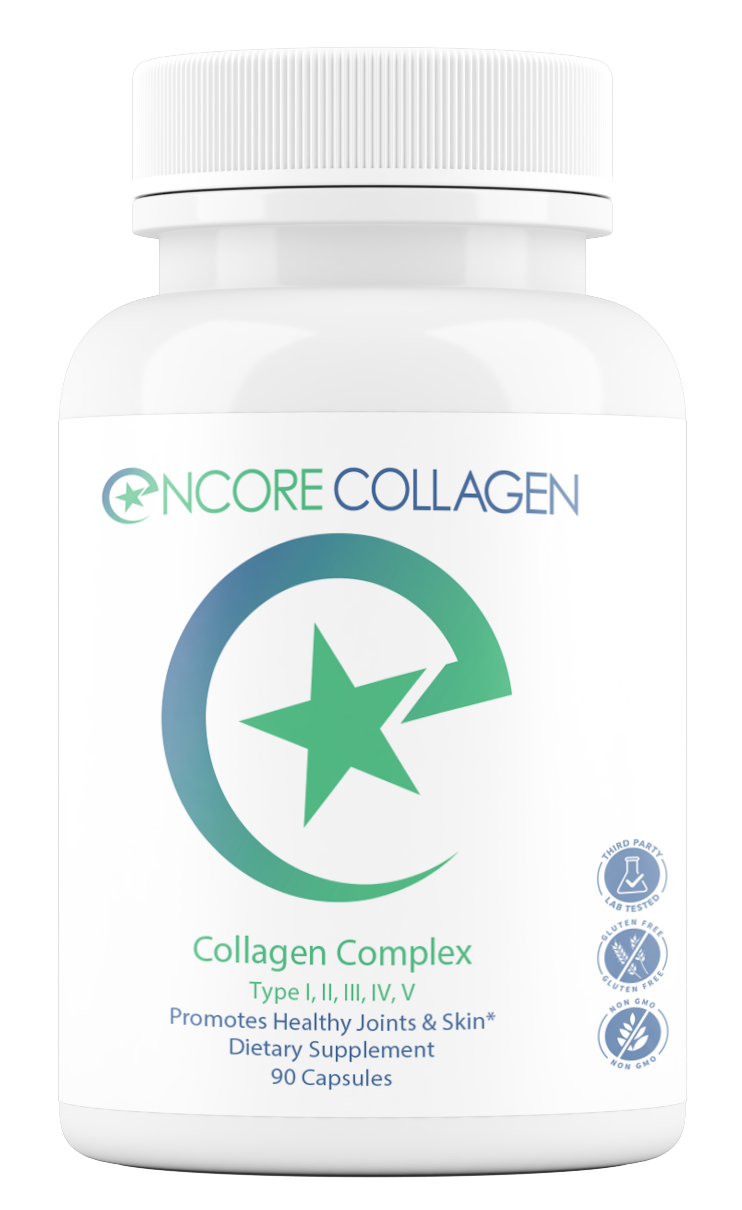
Encore Collagen Complex delivers all five collagen types (I through V) from five different sources — bovine, chicken, marine cod, eggshell membrane, and avian sternum. 1,800mg per serving to support skin, joints, hair, and bones during and after menopause.
Try Encore Collagen Complex →You can't stop menopause. But you can change how your body responds to the collagen decline it triggers.
Supplementation matters here. Your body still produces collagen after menopause — just less of it. Providing the raw building blocks through hydrolyzed collagen peptides gives your fibroblasts the amino acids (glycine, proline, hydroxyproline) they need to keep producing, even at reduced capacity.
Most collagen on the market contains only Type I or Type I and III. That misses the full picture. Type II supports your cartilage. Type IV maintains the basement membrane beneath your skin. Type V organizes new collagen fibers so they form properly.
A multi-type approach addresses the full scope of menopause-related changes — not just skin, but joints, hair, nails, and bone structure.
The earlier you start, the more collagen you preserve. Ideally, supplementation begins in your 40s — before the estrogen drop accelerates the decline. But starting post-menopause still makes a measurable difference.
Research published in the Journal of Cosmetic Dermatology found that women who supplemented with collagen peptides for 12 weeks showed significant improvements in skin elasticity, hydration, and dermal density — regardless of when they started.
The body doesn't stop responding to collagen. It just needs more support to keep up.
Encore Collagen Complex includes all five types of collagen from five distinct sources, delivering 1,800mg per serving. It's designed for women who want comprehensive collagen support — not just one type.
Menopause changes the equation. But it doesn't have to dictate the outcome. The collagen your body loses can be supported, rebuilt, and maintained — if you give it the right materials to work with.
Women lose up to 30% of their skin collagen in the first five years after menopause. After that, the decline continues at roughly 2% per year. This accelerated loss is directly tied to the drop in estrogen, which regulates collagen-producing fibroblasts.
Types I and III are the primary structural collagens in skin, responsible for firmness and elasticity. But Type IV supports the basement membrane beneath skin, and Type V helps organize new collagen fibers. A multi-type collagen that includes all five types addresses the full scope of menopause-related changes.
Ideally, before menopause begins. Collagen production starts declining around age 25 at roughly 1.5% per year. Starting supplementation in your 40s — before the estrogen-driven acceleration hits — gives your body a head start. But even post-menopause, supplementation supports the collagen your body is still producing.
1,800mg of five-source collagen per serving. Third party tested. GMP certified. 90-day money-back guarantee.
Order the Collagen Complex →