Skin Health
Under-Eye Wrinkles: The Collagen Types That Target Them

The skin under your eyes is the thinnest on your entire body — roughly half a millimeter, about five times thinner than the skin on your cheeks. It has almost no oil glands, very little fat padding underneath, and a sparse collagen scaffold to begin with. So when your collagen starts to decline, the under-eye area is the first place it shows.
That is why fine lines and crepey texture appear here years before they show up anywhere else on the face. It is not that this skin ages faster than the rest of you. It is that it had the least to lose in the first place.
Understanding which collagen types hold this fragile area together — and which ones drain out first — is the difference between chasing the problem with creams and actually addressing it.
Three things make this skin uniquely vulnerable. It is paper-thin, so there is very little structure to lose before damage becomes visible. The blood vessels sit close to the surface, which is why the area darkens and looks tired the moment circulation or hydration drops. And it never stops moving — the average person blinks more than 15,000 times a day, plus every squint, smile, and laugh folds this delicate skin over and over.
Beneath the surface, two structural proteins are supposed to keep it taut. Type I collagen is the dense, rope-like protein that gives skin its firmness and thickness. Type III collagen is the springier mesh woven alongside it that lets skin bounce back after every fold. Together they are the entire difference between smooth and crepey. As both decline with age — and they decline faster here because there was less to start with — the skin loses its snap and the folds stop fully releasing. Those held-open folds are what you see as fine lines.
Under-eye repair is not about one collagen type. It is about three working together, and most single-source supplements only deliver one or two of them.
Type I rebuilds the structural bulk — the firmness that keeps thin skin from looking hollow and crepey. Type III restores elasticity, the snap-back that releases a fold instead of leaving it etched in. If you have read our breakdown of Type III collagen and elasticity, you already know it is the protein most people overlook. And Type IV works deeper still — it forms the basement membrane that anchors the outer skin to the dermis below. Under-eye thinning is partly that anchoring layer weakening and the two sheets of skin pulling apart.
A supplement that covers only Type I gives you firmness without the elasticity that releases the lines. One that ignores Type IV skips the layer where thin skin literally comes unstuck. The under-eye needs all three rebuilt at once.
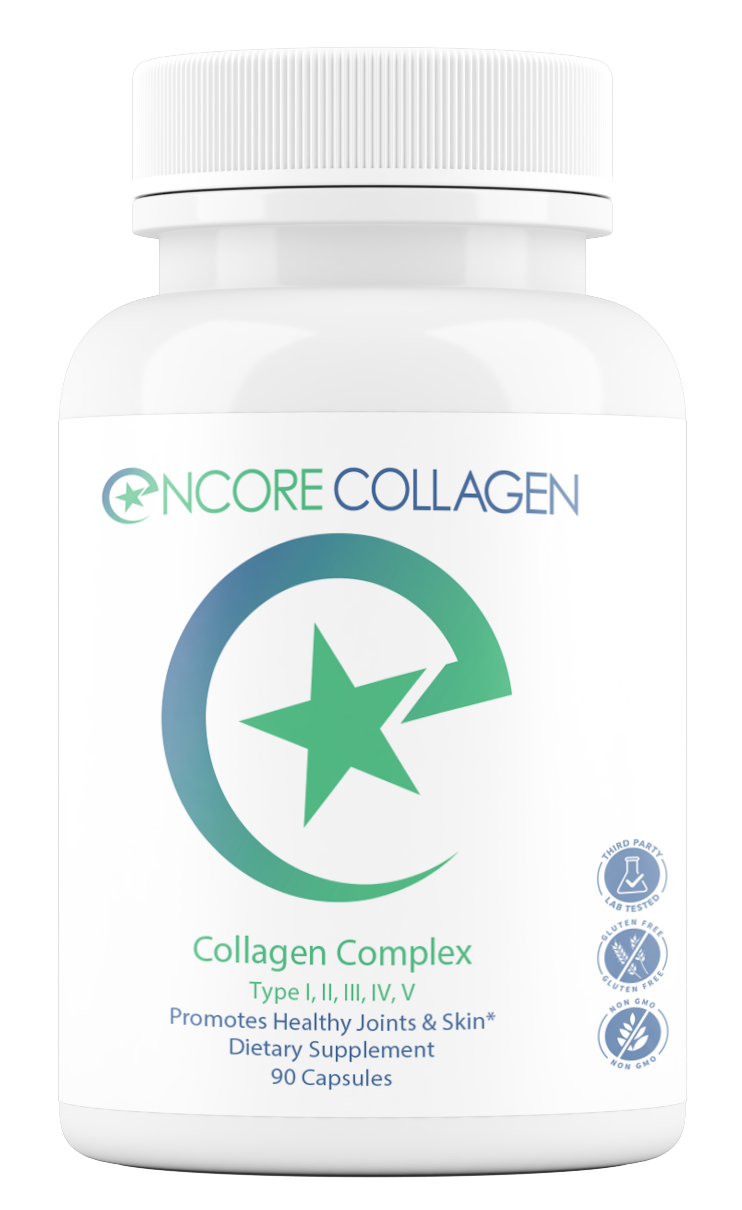
Encore Collagen Complex delivers Types I through V from five sources in a single 1,800mg serving — so the firmness, elasticity, and anchoring proteins under-eye skin needs all arrive together.
Order Now →Walk through the wrinkle aisle and nearly every eye cream lists collagen on the label. The problem is physics. A collagen molecule is far too large to penetrate past the surface and reach the dermis, which is the only place wrinkles actually form. Topical collagen sits on top of the skin.
That is not useless — surface hydration temporarily plumps fine lines and makes them look softer for a few hours. But it is a cosmetic effect, not a structural one. The moment the skin dries out, the line is back. Rebuilding the collagen scaffold has to happen from the inside, where your fibroblast cells live and where peptides delivered through the bloodstream can actually signal them to produce more.
Honesty matters with the under-eye, because it is the area people most want a miracle for. Oral collagen will not erase a deep, set-in crease overnight, and it is not a substitute for what a dermatologist's filler or laser does to volume loss. Anyone promising that is selling you something.
What the research does support: daily hydrolyzed collagen improved skin elasticity and hydration in multiple controlled trials over an 8-to-12-week window. That translates to firmer, better-hydrated under-eye skin, softer crepey texture, and a slower rate of new fine lines forming. It works on the trajectory, not the clock. Give it three months of consistency before you judge it.
Keep Reading
Under-eye wrinkles are not a sign you are doing something wrong. They are simply the first visible report of collagen loss, showing up where the skin is thinnest and the scaffold is sparsest. Creams can soften the surface, but the lines form in a layer they cannot reach. Rebuilding firmness, elasticity, and the anchoring membrane — Types I, III, and IV together — is an inside job, and it is the one approach that works on the cause rather than the appearance.
Encore Collagen Complex is built from five sources — bovine, chicken, marine cod, eggshell membrane, and avian sternum — to deliver Types I through V in one daily serving. The full spectrum the under-eye area needs, in fully hydrolyzed peptides sized for absorption.
Collagen supplements support the skin's structural proteins from the inside. In clinical trials, daily hydrolyzed collagen improved skin elasticity and hydration over 8 to 12 weeks, which softens the crepey texture and fine lines that show up first under the eyes. It works gradually by feeding the fibroblasts that rebuild the dermis, not by erasing deep wrinkles overnight.
Most studies show measurable changes in skin elasticity and hydration at the 8 to 12 week mark of daily use. Under-eye skin is the thinnest on the body, so improvements there often become visible around the same window as the rest of the face. Consistency matters more than dose timing.
They work in different places. Eye creams hydrate the surface and temporarily plump fine lines, but collagen molecules in topical products are too large to reach the dermis where wrinkles actually form. Oral collagen peptides travel through the bloodstream and signal the deeper skin layers to rebuild. The two approaches complement each other rather than compete.
1,800mg of five-source collagen per serving. Third party tested. GMP certified. 90-day money-back guarantee.
Order the Collagen Complex →