Collagen Loss
What's the Best Age to Start Taking Collagen?

Most people start taking collagen the year they finally notice something is wrong. The jawline softens. The knees announce themselves on the stairs. The hair thins at the part.
By then, the decline has been running for fifteen years.
Here is the honest answer to when you should start: your mid-twenties is when collagen production turns down, and your late twenties to early thirties is the best age to start taking collagen if the goal is holding onto what you have. If you are already past that, the answer is today — because the loss compounds, and every year you wait is a year you pay interest on.
Around age 25, collagen synthesis slows and you begin losing roughly 1% to 1.5% of your collagen every year. That is not a dramatic drop. It is a slow leak.
Run the math and it gets less comfortable. At 40 you have lost somewhere between 15% and 20% of the collagen you carried at 25. At 50, closer to 30%. At 60, you may be running on half.
Nobody notices at 30 because skin, cartilage and hair all have a buffer built in. You do not see the effect of the loss until the buffer is gone — and when it goes, it seems to go all at once.
Your late 20s and 30s — the prevention window. Production has slowed but the structure is still intact. Supplementing here is maintenance, not repair. It is the cheapest, easiest phase, and the one almost everyone skips because nothing looks wrong yet.
Your 40s — the catch-up window. Fine lines set in, skin holds less water, joints get louder after exercise. You have lost real ground, but the fibroblasts that build collagen are still responsive. Research on collagen peptides consistently shows measurable changes in skin elasticity and hydration in this group within 8 to 12 weeks.
Your 50s and beyond — the defense window. For women, menopause accelerates everything: up to 30% of skin collagen can go in the first five years after it begins. For men the curve is flatter, but it never flattens to zero. Supplementing here supports what is still there and slows the slide. It still works. It just works harder.
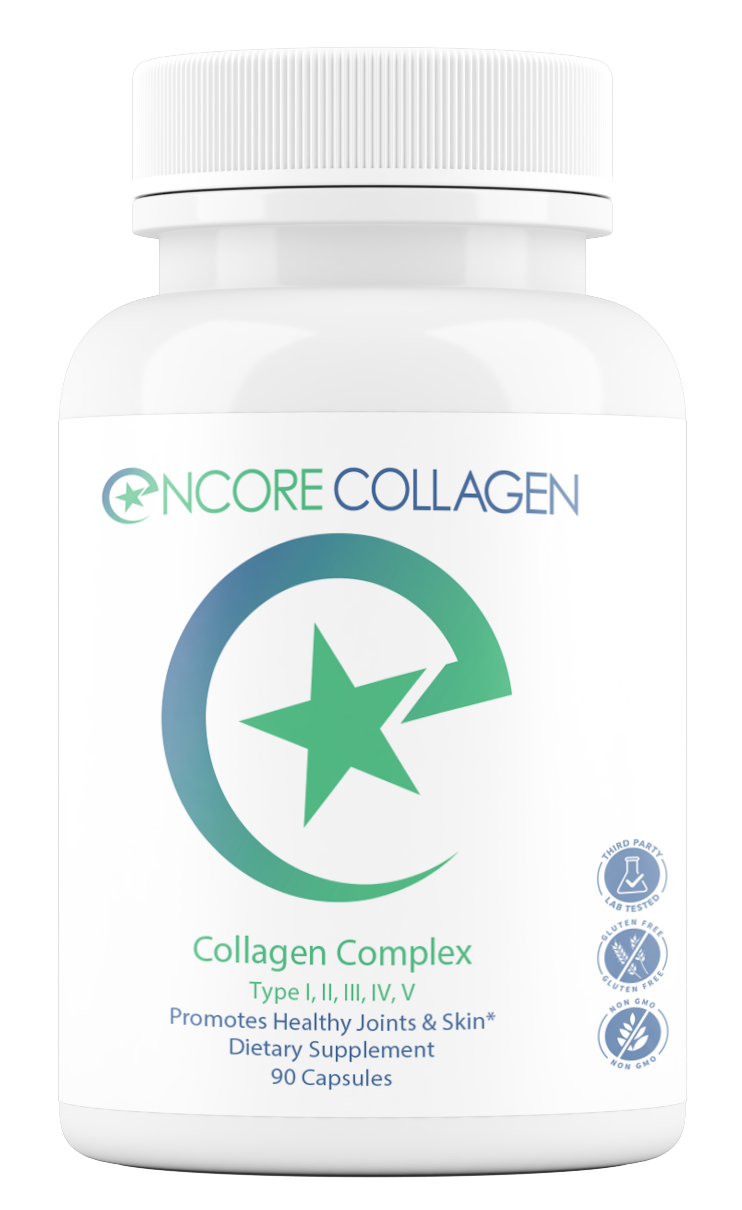
Encore Collagen Complex delivers 1,800mg of Types I, II, III, IV and V from five sources — bovine, chicken, marine cod, eggshell membrane and avian sternum. Skin, joints, hair and connective tissue in one serving, at any age.
See the FormulaCollagen is not a drug you take once for a result. It is a raw material your body draws on continuously.
Hydrolyzed collagen peptides are broken into fragments small enough to survive digestion and reach the bloodstream. Some of those fragments act as signals — they prompt fibroblasts to produce more collagen and hyaluronic acid on their own. That signaling response lands best when there is still a healthy population of fibroblasts to hear it.
That is the whole argument for starting sooner. Not that collagen stops working later, but that early on you are asking your body to maintain a factory. Later you are asking it to rebuild one.
Before about 20, your body produces more collagen than it loses. Supplementing does not hurt, but it is not solving anything either. Save your money.
Athletes are the exception. Heavy training loads tendons, ligaments and cartilage faster than they rebuild, and collagen support at 22 makes sense for a serious runner or lifter in a way it does not for someone the same age at a desk.
The age you begin matters less than what you actually take.
Most collagen on the shelf is Type I and III from a single bovine source. That covers skin and some connective tissue — and misses Type II entirely, which is what cartilage is built from. It also misses Type IV, which sits in the membrane beneath your skin, and Type V, which organizes the fibers the other types form.
Whether you are starting at 30 to prevent or at 55 to defend, you want the full set. Your body does not lose one type at a time.
Five types. Five sources. 1,800mg per serving, third-party tested and GMP certified — with a 90-day money-back guarantee, whether you are starting at 28 or 68.
The best age to start taking collagen is your late twenties, when you can still prevent the loss instead of chasing it.
The second-best age is whatever age you are today. Collagen decline does not pause while you decide, and the gap between 1.5% a year and 1.5% a year with support is the entire difference ten years from now.
No. Around 25 is exactly when natural collagen production begins to slow, which makes it the earliest point where supplementing has something to do. Before 20 your body still produces more than it loses, so there is little to gain unless you are training at high volume.
It is not. Fibroblast activity slows with age but it does not switch off, and studies on collagen peptides show improvements in skin elasticity and joint comfort in adults well past 60. Results generally take longer to show than they would at 35, so give it a full 90 days.
Most people report changes in nails and hair first, around 4 to 6 weeks. Skin hydration and elasticity typically show at 8 to 12 weeks, and joint comfort often takes 12 weeks or more. Consistency matters more than dose size.
The starting point is the same for both, since the mid-twenties slowdown is not sex-specific. The difference comes later: women lose collagen sharply around menopause, while men decline on a steadier, flatter curve. Men often notice it first in their joints rather than their skin.
1,800mg of five-source collagen per serving. Third party tested. GMP certified. 90-day money-back guarantee.
Order the Collagen Complex →