Collagen Loss
Should You Start Collagen in Your 30s? What the Science Says

The question comes up more now than it did five years ago. A woman at 34 who starts noticing a line that doesn't quite smooth out. A man at 38 who wonders why his knee complains after a basketball game that used to be nothing. People in their 30s asking the same thing from different directions — is it too early for collagen, or am I already late?
The science says the same thing to both of them: your 30s is exactly the right window. Not because something is wrong, but because this is the decade when the body's collagen math quietly flips from surplus to deficit.
Collagen production peaks in your late teens and holds steady through most of your 20s. Around age 25, synthesis begins to slow. By 30, most people are losing roughly 1 to 1.5 percent of their total collagen per year. By 35, the rate of fibroblast activity — the cells that build new collagen — has dropped measurably. By 40, cumulative loss is somewhere between 10 and 15 percent of your lifetime peak.
None of this feels dramatic from inside your own body. The slope is gentle. But it's the decade when the structural scaffolding under your skin, hair, nails, cartilage, and connective tissue starts getting withdrawn faster than it's being deposited. The decade-by-decade breakdown of collagen loss shows the 30s as the hinge point — the first full decade where the deficit accumulates.
The signs in your 30s are subtle because they're the beginning of change, not the result of it. A fine line at the outer corner of the eye that stays after you stop smiling. Hair that feels slightly thinner through the fingers in the shower. Nails that split at the free edge instead of growing out clean. The back of the hand that takes a half-second longer to spring back when you pinch the skin. A knee that stiffens after a long drive.
Individually, each of these is nothing. Taken together, they are the structural signature of slowing collagen turnover. The body is still producing — it's just producing less than it's using. That's the point when a daily protocol starts earning its keep.
Neither. The question itself misses the shape of the curve. Starting collagen at 30 is not treating a problem — it's preventing a deficit from compounding. Starting at 38 is not catching up on lost time — it's supporting skin and connective tissue while there is still plenty of structure to maintain. The research on hydrolyzed collagen shows measurable improvements in skin elasticity and hydration within 8 to 12 weeks of daily supplementation at every adult age tested. The earlier you start, the less distance there is to close later.
People who start in their 30s usually report the fastest subjective results — not because the product works harder in a younger body, but because there's less accumulated deficit to fill. Nails are often the first thing people notice, and the skin studies measure changes at 8 to 12 weeks.
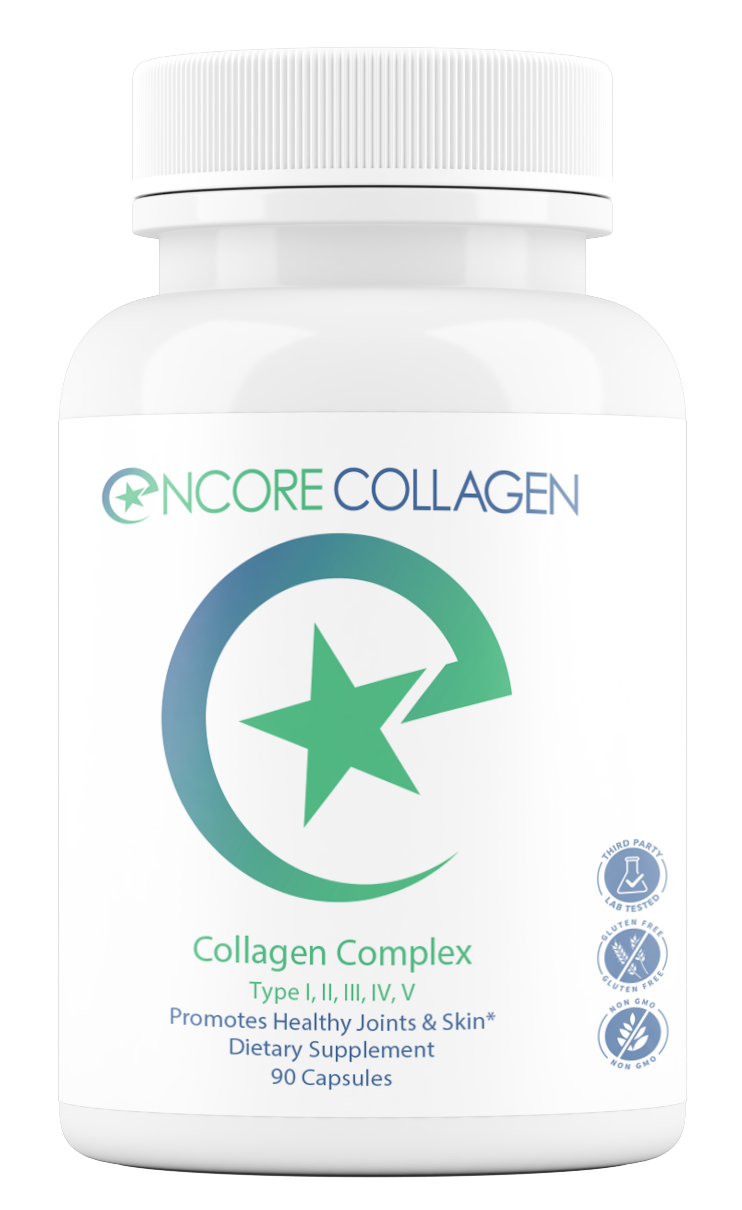
Encore Collagen Complex delivers 1,800mg of Types I, II, III, IV, and V — the complete multi-type scaffold your body stops building efficiently somewhere in your 30s.
See the Complex →In your 50s, you're trying to fill a deeper deficit — the loss has been accumulating for twenty years. In your 30s, you're trying to preserve a scaffold that is still mostly intact. The job is different. Preservation requires feeding every structure the body is still actively maintaining — the Type I in your skin and tendons, the Type II in your cartilage, the Type III in your blood vessel and organ walls, the Type IV in your dermal-epidermal junction, the Type V in your hair, cornea, and placental tissue.
Your body digests any collagen into amino acids and small peptides, so a single source still delivers the building blocks. A multi-source formula adds breadth - Type II from cartilage sources alongside the Type I and III in hide and fish - which is why some people prefer it for skin and joints together. That's the reason the 5 types of collagen peptides work together instead of individually — each one builds a different part of the body, and your 30s is the first decade when all of them need a little outside help.
Simple is better than clever at this age. Four things carry the entire program.
Daily, not sporadic. Take your serving of hydrolyzed collagen every day, alongside vitamin C from food or a supplement - your body needs vitamin C to assemble new collagen. The skin studies that show results used daily intake over weeks, not an occasional dose.
Multi-type over single-type. Your 30s is a maintenance decade. Maintenance of a multi-structure system requires a multi-source input. A formula with Types I-V covers the full scaffold.
Pair it with the behaviors that build collagen anyway. Good sleep supports tissue repair. Sunscreen protects what you already have — UV is the single biggest accelerator of collagen degradation. Resistance training signals the body to maintain connective tissue. Vitamin C and zinc in the diet feed the enzymatic machinery.
Give it time. Hair and nail changes show up first because they grow visibly. Skin changes take 8 to 12 weeks because the dermis turns over slowly. Joint changes take longer still. The protocol works on biological time, not visible time.
Encore Collagen Complex blends five bovine, chicken, marine, and eggshell-membrane sources so your 30s routine delivers every type at once — the way your body actually uses it.
Weeks 1 to 4: Nails stop splitting as readily. Hair feels slightly stronger between washes. Nothing dramatic — the first signal that the amino acid pool is loaded.
Weeks 4 to 8: Skin feels more hydrated. Fingernails grow out at an even thickness.
Weeks 8 to 12: Skin texture smooths. Fine lines look softer. Any joint stiffness that was present starts to loosen.
Months 3 to 6: Consistency matters more than anything here. The benefits in the studies hold while people keep taking collagen daily.
Thirty is not too early. Thirty-eight is not too late. Your 30s is the decade the body first asks for outside help with a job it used to do unassisted. The people who answer that question with a daily protocol compound the benefit for twenty years. The people who wait until 50 to start are not past the point of recovery — they just have more ground to make up. The best time to begin is the decade you're in now.
No. Collagen production begins declining around age 25, and by the early 30s most people are losing roughly 1 to 1.5 percent of their collagen each year. Starting a daily multi-type collagen in your 30s gives the body the raw material it needs during the exact window when natural synthesis first starts falling behind demand. Earlier is better than later — the goal is to slow the slope of decline, not reverse damage that already happened.
Not even close. At 38 you've likely lost around 10 to 15 percent of your lifetime collagen peak. That is meaningful, but there is still plenty of structure to support. In the skin studies, daily hydrolyzed collagen showed measurable changes in elasticity and hydration within 8 to 12 weeks across adult age groups. The sooner you start, the less ground you have to make up.
The first signs are subtle. Fine lines around the eyes and mouth that don't fully smooth out when your face is relaxed. Hair that feels thinner between the fingers when you wash it. Nails that split or peel more than they used to. A faint stiffness in the knees after sitting cross-legged. Skin on the back of the hand that takes a half-second longer to spring back when you pinch it. None of these are dramatic in isolation, but together they're the early signal that collagen turnover has slowed down.
Five types of collagen, 1,800mg per serving, formulated for the decade your body first starts losing more than it builds.
Order Encore Collagen Complex