Skin Health
Collagen for Stretch Marks: What It Can and Can't Do

Stretch marks are not a surface problem. They are tears in the collagen network under your skin, which is exactly why people ask about collagen for stretch marks - and why the honest answer has two parts.
Collagen can support the skin that is doing the stretching. It will not erase a mark that has already healed. Knowing where that line sits saves you a lot of money and a lot of disappointment.
Your dermis, the thick layer beneath the surface, is a mesh of collagen fibers held in tension, with elastin woven through it so the skin can snap back.
When skin is stretched faster than that mesh can remodel, the fibers pull apart. The body patches the gap with thinner, straighter collagen laid down in parallel lines - closer to scar tissue than to the original basket-weave. That patch is the stretch mark. Doctors call it striae distensae.
It happens to far more people than most assume. Estimates for pregnancy run from about half of women to as many as 90%. Teenagers get them during growth spurts, and so do plenty of men - lifters who bulk quickly get them across the shoulders and chest, and rapid weight gain puts them on anyone's hips and stomach.
Stretch marks go through two stages, and they behave very differently.
New marks are red, pink or purple. The tissue is still inflamed, still has blood supply, and is still being remodeled. This is the window where anything - topical or nutritional - has a realistic chance to influence how the skin rebuilds.
Mature marks are white or silver. The remodeling is finished. The new collagen is set in its flat, parallel pattern, and the elastic fibers in the mark are sparse and disorganized. At this stage, no cream or supplement rebuilds the original structure. Dermatologists use lasers and microneedling here, and even those improve texture rather than remove the mark.
If someone promises that a supplement will make old white stretch marks vanish, they are selling something.
The real value of collagen is in the skin that has not torn yet, and in marks that are still new.
Your fibroblasts - the cells that build the dermis - need glycine, proline and hydroxyproline to make new collagen fibers. Hydrolyzed collagen peptides deliver those building blocks in a form your gut absorbs well, and some peptides appear to act as signals that nudge fibroblasts to produce more.
The skin research backs this up. In a well-known 2014 double-blind trial, women aged 35 to 55 taking 2.5 to 5 grams of collagen peptides daily showed measurably better skin elasticity after eight weeks than those on placebo. Other trials have found improved dermal density and hydration.
None of those studies measured stretch marks directly. But elasticity and dermal density are exactly the properties that decide whether skin stretches or tears. Better-supplied skin has more room to give.
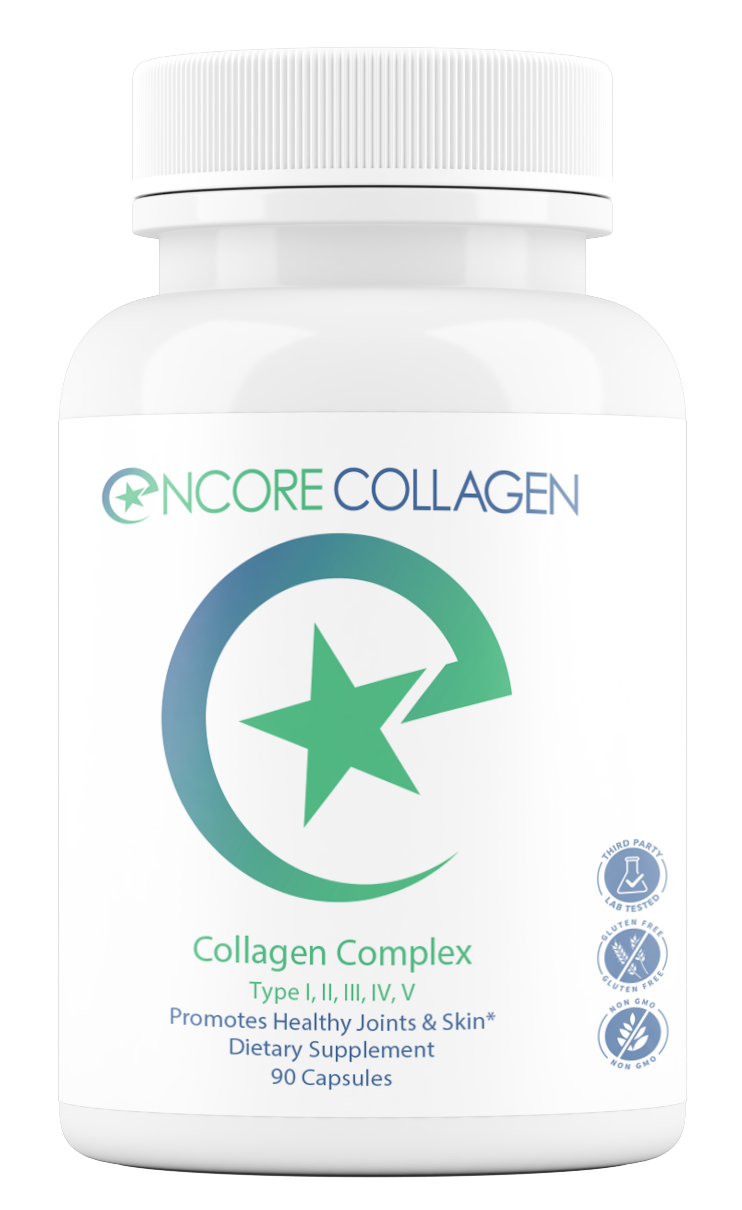
Encore Collagen Complex combines Types I and III for dermal strength with eggshell membrane collagen and hyaluronic acid - the structure and the hydration your skin draws on when it has to stretch.
See the FormulaType I is the tensile cable of the dermis. It is what resists tearing in the first place.
Type III is the flexible partner. It is abundant in young, stretchy skin and is the first collagen laid down when tissue is repairing - which is why Type III matters most while a mark is still red.
Type IV forms the basement membrane that anchors your skin's surface to the dermis below. When that anchor is weak, stretched skin looks thinner and more crepey. More on that in our breakdown of Type IV collagen.
Add hyaluronic acid to the list. Well-hydrated dermis is more pliable, and pliable tissue stretches further before it tears.
Think about collagen as preparation, not repair. It fits best before and during the periods when skin is asked to stretch fast: a planned bulk in the gym, a big change in body weight in either direction, or the years after 40 when natural production is already falling by roughly 1% a year.
Give it time. Skin trials show changes at eight to twelve weeks, not days. Pair it with the basics that protect the collagen you already have - sunscreen on exposed marks, enough protein and vitamin C, and not smoking.
If you are pregnant or nursing, ask your doctor before adding any supplement. And if new marks appear without an obvious cause like growth or weight gain, get them checked - they can occasionally point to a hormonal issue worth knowing about.
Encore Collagen Complex draws on five sources - bovine hide, chicken, marine cod, eggshell membrane and avian sternum - to supply Types I through V alongside hyaluronic acid, so the skin you are asking to stretch has the full set of building blocks.
Collagen will not rewrite a scar that has already set. What it can do is keep the mesh under your skin better supplied, so the next time your body changes shape, there is more structure there to take the strain.
Not mature ones. White or silver stretch marks are settled, scar-like tissue, and no supplement restores the original collagen structure. Collagen peptides are best viewed as support for skin that is still stretching and for new red marks that are still remodeling, alongside any treatment your dermatologist recommends.
Clinical trials on collagen peptides and skin elasticity typically report measurable changes after eight to twelve weeks of daily use. Consistency matters more than timing, so take it at whatever time of day you will remember.
Yes. Men commonly get stretch marks during adolescent growth spurts, rapid weight gain, and fast muscle gain from strength training, especially on the shoulders, chest, arms and lower back. The underlying mechanism - collagen fibers tearing under fast stretch - is the same for everyone.
1,800mg of five-source collagen per serving. Third party tested. GMP certified. 90-day money-back guarantee.
Order the Collagen Complex →