Skin & Aging
Collagen for Loose Skin After Weight Loss: What Actually Works
You lost the weight. The scale is finally where you wanted it. And then you look in the mirror and see skin that hasn't caught up. Loose under the arms. Slack across the belly. A softness at the jawline that no amount of contouring hides.
This is one of the most common frustrations of intentional weight loss — and one of the least talked about. Especially now, in the GLP-1 era, when people are dropping 40, 60, sometimes 100 pounds faster than the body was ever designed to lose it.
Here is what is actually happening in your skin, and what collagen can and cannot do about it.
Skin is not a rubber band. When you gain weight, the dermis — the deep structural layer — stretches and produces new collagen and elastin to accommodate the volume. Some of that new tissue is permanent. When the weight comes off, the tissue that was built to hold it doesn't just disappear.
The dermis has to actively remodel. Fibroblasts (the cells that make collagen and elastin) have to break down excess matrix and rebuild a smaller, tighter version. This is a slow process. It requires raw material. And it happens more efficiently when weight is lost gradually — the classic guidance of one to two pounds per week exists partly for exactly this reason.
Elastin is the other half of the equation. Elastin is what gives skin its snap. Unlike collagen, elastin is barely replaced after your mid-twenties. Once it stretches past a certain point, it stays stretched. This is why teenagers bounce back from weight fluctuations and forty-year-olds don't.
Semaglutide, tirzepatide, and other GLP-1 medications frequently produce weight loss at rates that would have been considered dangerous a decade ago. Two to four pounds a week is common. For the dermis, this is a problem. Skin remodeling is slower than fat loss. Full stop.
When the timeline mismatches, you get what dermatologists have started calling "Ozempic face" (and Ozempic arms, and Ozempic belly). The fat pads that gave the skin its shape are gone before the dermis has had a chance to adapt. The skin is technically the same size — it just no longer has anything holding it out.
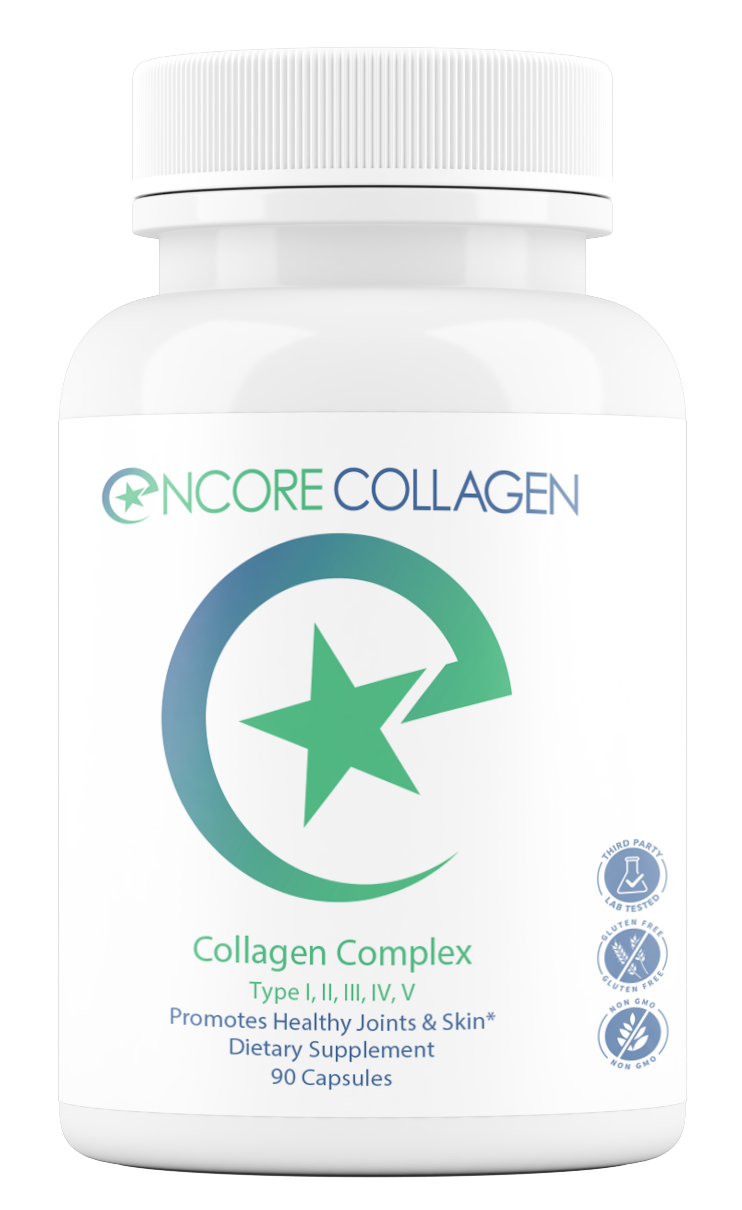
Encore Collagen Complex delivers 1,800mg of Types I, II, III, IV, and V collagen from five sources — the specific types your dermis draws from when it needs to remodel.
Order the Complex →Collagen supplements do not "shrink" loose skin the way a topical marketing ad implies. What they do — and what the research actually supports — is give the fibroblasts more of the amino acid raw material they need to build new dermal matrix during a period of active remodeling.
A 2019 meta-analysis published in the Journal of Drugs in Dermatology pooled 11 randomized controlled trials on hydrolyzed collagen peptides. Across 805 participants, supplementation for 8-12 weeks produced statistically significant improvements in skin elasticity, hydration, and dermal collagen density. These are the exact three variables that determine how well skin adapts after volume loss.
A separate 2015 study in Skin Pharmacology and Physiology found that 2.5g of collagen peptides daily for 8 weeks improved skin elasticity by around 15% in women aged 35-55. That is not cosmetic — that is measurable change in how the dermis behaves.
Translation: collagen supplementation supports the biological process of skin adapting to a smaller body. It is a raw material input, not a magic fix.
Most people start looking at loose skin solutions after the weight is already off. That is the wrong window.
Skin remodeling happens during weight loss, not after. If you are on a GLP-1, or in a serious deficit, or coming off a bariatric procedure — the time to give your dermis raw material is now, while the loss is happening. Every week you supplement during the loss phase is a week your fibroblasts have the amino acids they need to keep pace.
Starting after the fact is not useless — dermal turnover continues for months to years — but you have missed the highest-leverage window.
Type I collagen is the most abundant in the dermis and the most obvious target. But Type III is the elasticity-adjacent scaffolding that co-locates with Type I and matters enormously during periods of active remodeling. Type IV forms the basement membrane between the dermis and epidermis — the junction that has to stay intact when skin is contracting.
Single-source Type I supplements miss two-thirds of the picture. A multi-type complex covers the full dermal architecture. For a deeper look at why each type contributes something different, see our breakdown of the 5 types of collagen and the specific role of Type III collagen in elastic connective tissue.
Collagen alone is one input. The dermis also responds to:
Adequate protein. If your total protein intake is low, no amount of collagen will make up for it. Aim for 0.7-1g per pound of goal bodyweight during a loss phase. Collagen is a supplement to a high-protein diet, not a substitute for it.
Resistance training. Building or preserving muscle underneath the skin gives the dermis something to drape over. Sagging is often as much about lost muscle as it is about lost fat.
Hydration and vitamin C. Fibroblasts require vitamin C as a cofactor to actually assemble collagen fibers. Deficiency here is a bottleneck no supplement can bypass.
Time. Dermal remodeling takes 6-18 months to reach its final state after weight stabilizes. Loose skin at month 3 is not the same as loose skin at month 12.
Encore Collagen Complex delivers all five types — I, II, III, IV, and V — from bovine, chicken, marine cod, eggshell membrane, and avian sternum. 1,800mg per serving. Third-party tested. If your body is doing the work of remodeling, this is the raw material it needs.
Collagen supplementation cannot reverse skin that has been extremely overstretched for a decade. If you have lost 100+ pounds and have significant excess skin folds, surgical revision remains the only reliable option for that specific problem.
But for the far more common case — moderate loose skin after a 20-60 pound loss, or the softness that shows up in a GLP-1 timeline — collagen is one of the genuinely evidence-supported tools. Combined with adequate protein, resistance training, and patience, it gives your dermis the best chance to catch up with the rest of you.
The window is now, not later. Start during the loss, not after.
Collagen supplementation cannot reverse skin that has been extremely overstretched for years, but multiple clinical trials show hydrolyzed collagen peptides significantly improve skin elasticity, hydration, and dermal density within 8-12 weeks. For mild to moderate loose skin, this improvement is often visible. For severe cases after 100-plus pound losses, collagen supports repair but surgical revision may still be needed.
Ideally, start collagen during the weight loss phase, not after. Skin remodeling happens while you are losing, not once you are done. Taking 10-15g of hydrolyzed collagen daily throughout an intentional weight loss period gives your dermis the raw material to shrink alongside your body rather than lag behind it.
GLP-1 medications like semaglutide often produce weight loss too fast for skin to keep up. Collagen supplementation supports the fibroblast activity needed for dermal remodeling. It will not prevent all loose skin from very rapid loss, but it gives the dermis its best chance to adapt. Pair it with resistance training and adequate protein intake.
1,800mg of five-source collagen per serving. Third party tested. GMP certified. 90-day money-back guarantee.
Order the Collagen Complex →