Why Collagen
Collagen and Bone Density: The Skeleton's Living Scaffold
When most people think about bone, they think about calcium. Milk. Osteoporosis ads. A hard, white, mineral thing sitting under the skin.
That picture is half wrong.
Bone is not a rock. Bone is a living tissue that is constantly being torn down and rebuilt — and about 30% of its dry weight is collagen. Take away the collagen and you're left with a pile of chalk. Brittle, fragile, and useless as a load-bearing structure.
The strength of your skeleton depends on the framework as much as the fill. And that framework is protein.
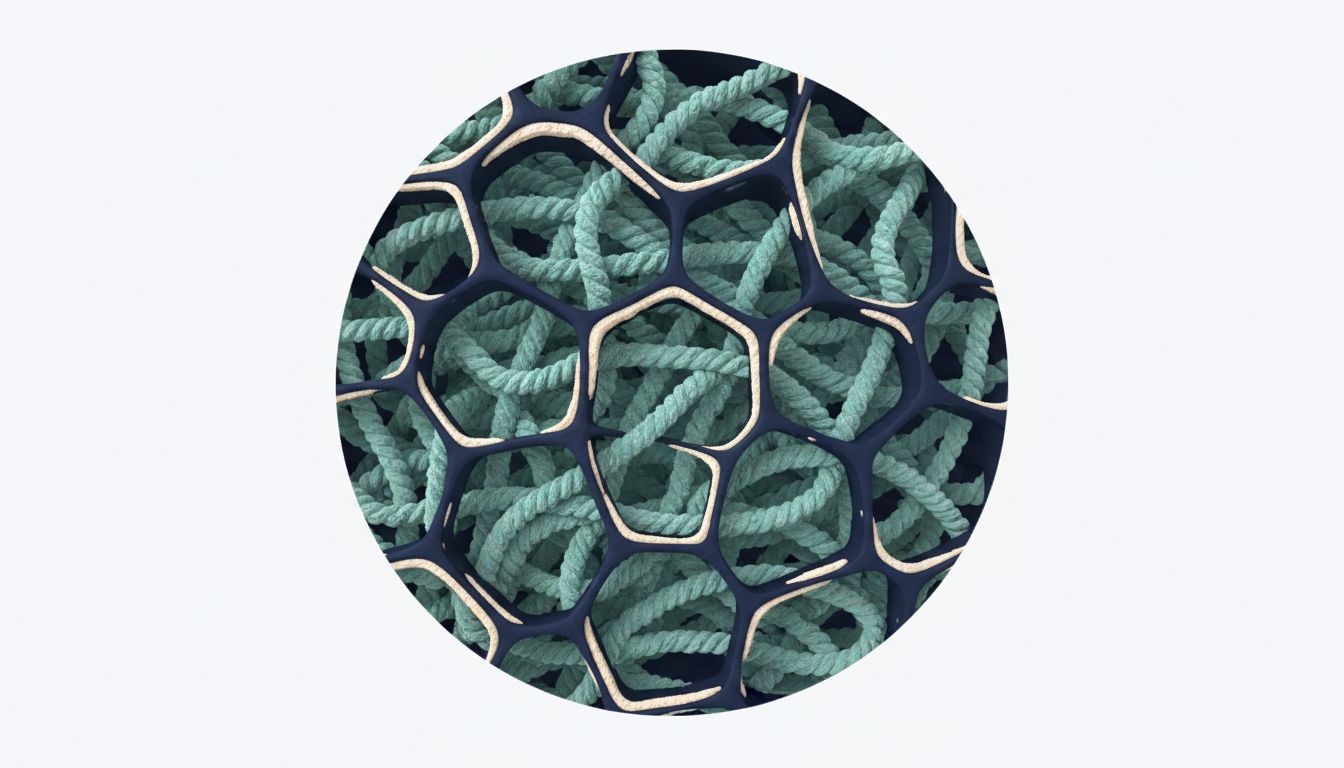
Cortical bone — the dense outer shell — is roughly two-thirds mineral (mostly hydroxyapatite, a calcium-phosphate crystal) and one-third organic. That organic third is almost entirely Type I collagen, arranged in tight triple helices that layer into fibrils, which layer into fibers, which layer into the bone matrix itself.
The minerals crystallize onto the collagen. Not beside it. Not around it. Onto it. The collagen scaffold comes first, and the calcium deposits fill the framework the same way concrete fills rebar.
This is why bone is both hard and flexible. Pure mineral would shatter under load. Pure collagen would bend like cartilage. Combined, they give you a material that can hold up a body for 90 years and still absorb a fall without snapping.
Peak bone mass hits somewhere around age 30. After that, most adults lose roughly 0.5% to 1% per year. It's slow enough that you don't notice — until you do.
Two things are happening at once. First, collagen production drops. The same 1% to 1.5% annual decline that thins your skin also thins the protein framework inside your bones. Second, the balance between osteoblasts (cells that build bone) and osteoclasts (cells that break it down) tips toward breakdown.
Women get hit harder and faster. In the first five years after menopause, bone loss can accelerate to 2% or 3% per year as estrogen — which suppresses osteoclast activity — drops off. Men lose bone more slowly but end up in the same territory by their late 70s.
The result is the same: less scaffold, less mineral, thinner bones, higher fracture risk.
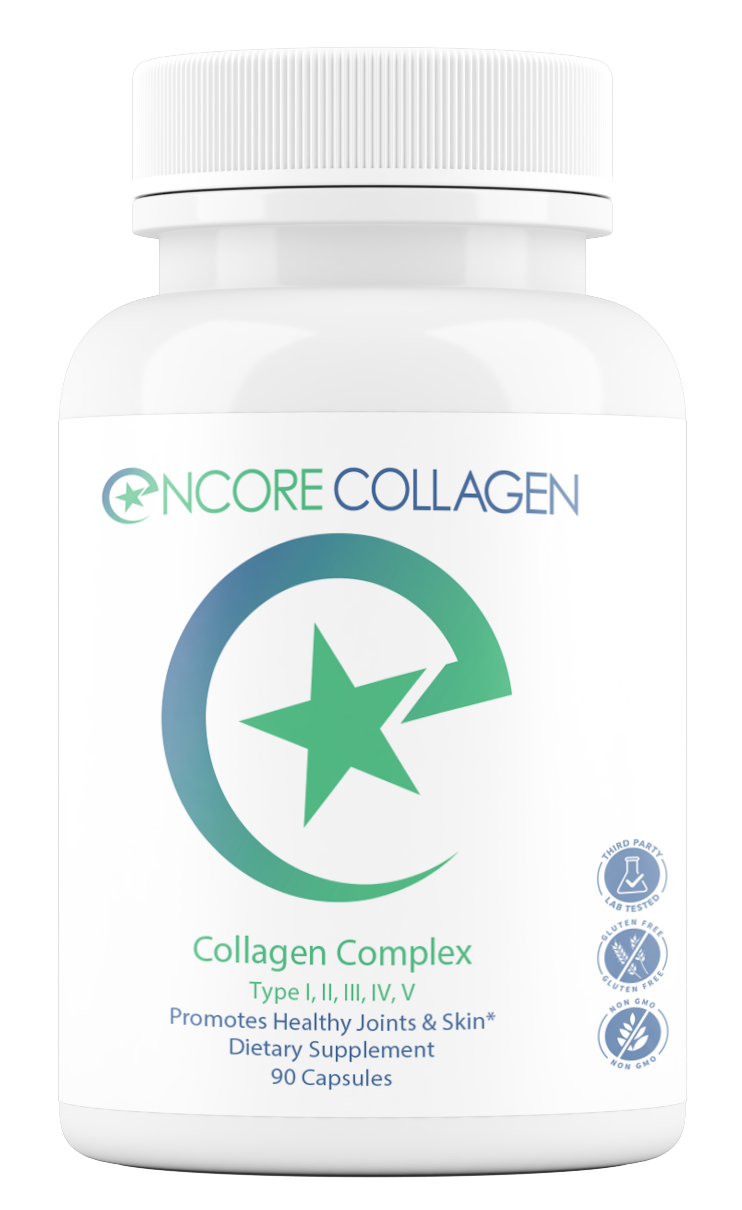
Encore Collagen Complex delivers 1,800mg of five collagen types per serving — including the Type I that builds your bones' framework.
Order NowThe interesting question is whether swallowing collagen actually reaches bone tissue. For a long time the assumption was that it wouldn't — that the peptides would just get broken down and used as generic amino acids.
Then a 2018 randomized trial published in Nutrients gave 131 postmenopausal women 5g of specific collagen peptides daily for a full year. The results were striking. Spinal bone mineral density rose 3.0% versus placebo. Femoral neck density rose 6.7%. Blood markers showed increased bone formation and decreased breakdown.
A follow-up in 2021 tracked the same participants for four years and found the gains held — women who kept taking the peptides continued to build density while the placebo group continued to lose it.
The proposed mechanism is that specific collagen peptides survive digestion, reach the bloodstream, and act as signaling molecules. They appear to prompt osteoblasts to lay down more matrix.
This doesn't replace weight-bearing exercise or adequate calcium and vitamin D — those are still the load-bearing pieces of any bone protocol. But it does mean the raw material matters, and most adults are running short on it.
Type I is the dominant collagen in bone, but the skeletal system doesn't stop at bone. Cartilage at joint surfaces is Type II. The membranes lining blood vessels running through bone are Type IV. The connective tissue anchoring tendons to bone is a mix of Types I, III, and V.
A multi-type collagen supplement gives the body the full protein alphabet — not just the framework material, but the surrounding connective tissue that lets bone function inside a living skeleton. When one type is missing, the surrounding structures compensate poorly. When all five are available, the body can direct the material wherever repair is happening.
Keep Reading
Bone is a composite material — mineral crystallized onto a protein framework — and both halves matter. Calcium without collagen is chalk. Collagen without calcium is cartilage. The skeleton needs both, and after 30 your body makes progressively less of the protein half.
Getting enough of the right collagen types every day gives the framework something to rebuild with. That's the point of supplementation: not a miracle, just adequate raw material.
Encore Collagen Complex includes all five collagen types — Type I for bone framework, plus II, III, IV, and V for the surrounding connective tissue that keeps a skeleton functional.
Yes. A 2018 randomized trial in Nutrients found that postmenopausal women who took 5g of specific collagen peptides daily for one year had a 3.0% increase in spinal bone mineral density and 6.7% at the femoral neck, compared to placebo. The peptides appear to stimulate osteoblasts — the cells that build bone.
Calcium is the hardness. Collagen is the framework that holds the calcium in place. About 30% of dry bone weight is Type I collagen. Without the collagen scaffold, minerals have nothing to bind to — which is why bones can be mineral-rich and still brittle.
Bone mass peaks around age 30. After that, most adults lose about 0.5% to 1% per year. Women lose an additional 2-3% per year in the first five years after menopause as estrogen drops. Men decline more slowly but hit the same problem — just later.
1,800mg of five-source collagen per serving. Third party tested. GMP certified. 90-day money-back guarantee.
Order the Collagen Complex →