Joint Health
Hip Stiffness After 50: The Collagen Connection

You used to stand up from the couch without thinking about it. Now there is a pause. A slight catch in the hip. A stiffness that works itself out after a few steps but never fully disappears.
It is one of the most common complaints from people over 50 and it is rarely a single-cause problem. But if you strip away the usual suspects (a tight muscle here, a pinched nerve there), what you find underneath is almost always the same thing: cartilage and ligament tissue that is running low on the raw material it needs to stay resilient.
That raw material is collagen.
The hip is the largest weight-bearing joint in the body. Every step you take runs force through a thin cushion of cartilage coating the head of the femur and the socket it sits in. That cushion is about 80% collagen by dry weight, specifically Type II collagen.
Cartilage has no blood supply. It cannot call in reinforcements the way muscle or skin can. It relies on a slow, steady drip of amino acids circulating through joint fluid to repair daily wear. When collagen production declines, which it does at roughly 1.5% per year after age 30, that repair drip slows down too.
The result is not a dramatic injury. It is a slow thinning of the cushion. Less shock absorption. More grinding of bone against bone. And a hip joint that feels different in your 50s than it did in your 30s, even if nothing dramatic happened to it.
The hip is held together by ligaments and a joint capsule made mostly of Type I and Type III collagen. These tissues give the hip its stability and allow it to rotate through its full range of motion.
As collagen production drops, ligaments become slightly less elastic. Tendons lose some of their glide. The fascia around the hip tightens. None of this shows up on an X-ray, but it shows up every time you try to put on a sock without sitting down.
So when people over 50 describe hip stiffness, they are usually dealing with two connected problems at once: thinning cartilage and stiffening connective tissue. A good collagen strategy addresses both.
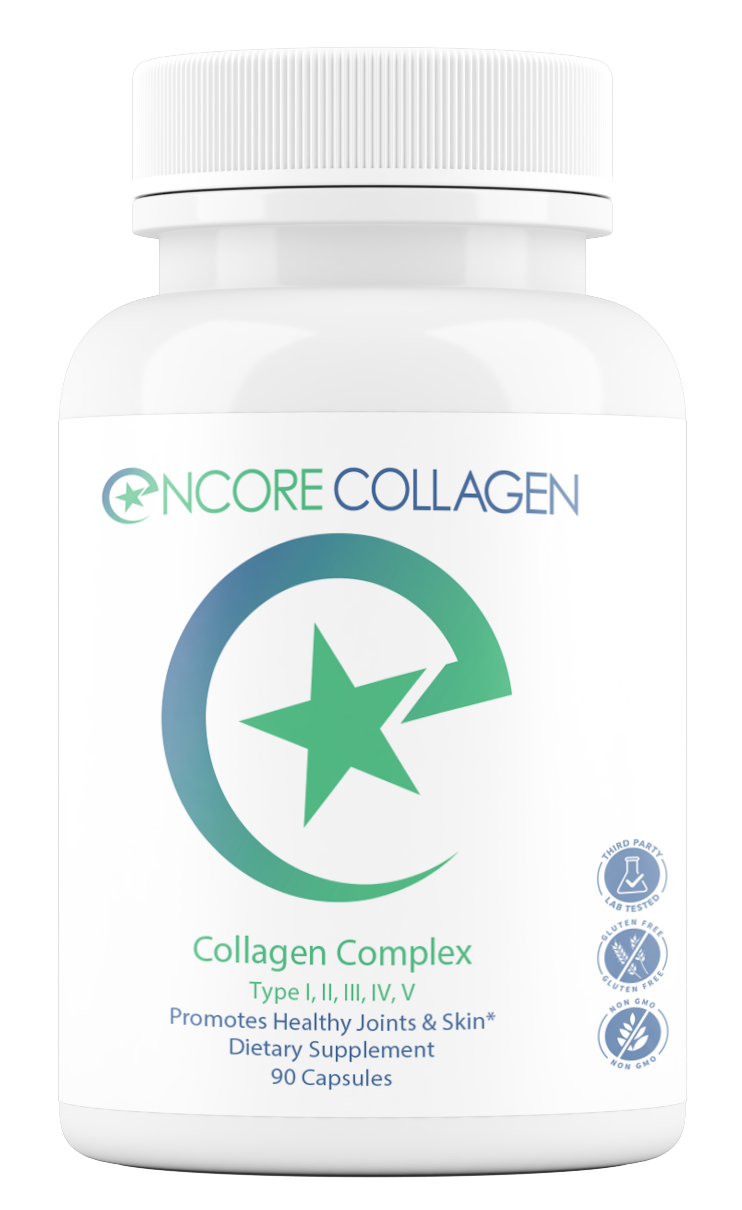
Encore Collagen Complex delivers Type II collagen for cartilage plus Types I and III for ligaments and joint capsule, the three collagens the hip relies on most.
Try It Risk-Free →A 2008 trial published in Current Medical Research and Opinion followed 147 athletes for 24 weeks. Those taking 10 grams of collagen peptides daily reported significantly less joint pain during activity and at rest compared with the placebo group, with the hip being one of the most-cited sites of improvement.
A separate 2017 review in Nutrients concluded that undenatured Type II collagen, taken in small daily doses, supported joint comfort and range of motion in people with age-related cartilage wear. The mechanism is not flashy: the collagen acts as a chronic low-level signal to the immune system, which in turn eases the inflammatory activity that accelerates cartilage breakdown.
Neither study promises a reversal of structural damage. What they show is that the underlying process, the one grinding away at the hip every day, can be slowed down with the right inputs.
A Type I-only collagen, the kind found in most marine powders, does very little for cartilage. It supports skin, hair, and the outer ligament structure, but the hip cartilage itself needs Type II.
A comprehensive formula includes all five collagen types. Type II comes from chicken cartilage and avian sternum. Types I and III come from bovine and eggshell membrane. Type V helps organize the fibers during formation. Together, they match the collagen profile your hip actually uses.
If joint stiffness is the reason you are considering collagen, a single-source product is almost always the wrong choice. The hip needs a full spectrum.
Encore Collagen Complex provides 1,800mg of Types I-V collagen from five natural sources, including Type II from chicken sternum and avian cartilage, the exact collagen the hip joint is made of. Learn more →
Hip stiffness after 50 is rarely about one bad movement or one bad day. It is the slow reveal of collagen your body has been quietly losing for 20 years.
You cannot stop the clock. But you can change what you feed the repair process. Daily collagen, the right types from the right sources, gives your hip cartilage and ligaments the amino acids they have been running low on. The result is not a miracle. It is a joint that has what it needs to keep working the way it is supposed to.
Research suggests yes, particularly for age-related hip stiffness tied to cartilage wear. A 2008 study in Current Medical Research and Opinion found athletes taking 10g of collagen peptides daily for 24 weeks reported significantly less joint pain, including in the hips, during activity and at rest.
Type II collagen is the specific collagen found in cartilage. Types I and III support the surrounding ligaments and tendons that stabilize the hip. A multi-type complex that includes Types I, II, and III covers both the cushioning and the structural components.
Most clinical studies show measurable improvements in stiffness and range of motion within 12 to 24 weeks of daily use. Cartilage remodels slowly so consistency matters more than dose.
1,800mg of five-source collagen per serving. Third party tested. GMP certified. 90-day money-back guarantee.
Order the Collagen Complex →