Collagen Types
Type V Collagen: The Hidden Scaffold That Organizes Your Body
Most collagen articles cover Types I, II, and III. Those are the famous ones — skin, cartilage, blood vessels. But there's a fourth and a fifth that almost nobody talks about, and the fifth one might be the most quietly important of all.
Type V collagen makes up less than 5% of the total collagen in your body. It's rare, hard to source, and most supplements skip it entirely. That's a problem — because Type V is the protein that tells the other collagens how to form in the first place.
Think of your connective tissue as a building. Type I collagen is the steel beams — abundant, strong, load-bearing. Type III gives the walls their flexibility. Type V is the blueprint that the construction crew follows.
Type V molecules embed inside the larger Type I fibers and dictate their diameter and orientation. Without enough Type V, Type I fibers grow too thick, form in irregular patterns, and lose their tensile strength. The mechanical properties of your skin, bone, and connective tissue all depend on this organizing role.
This was confirmed in studies of classical Ehlers-Danlos syndrome, where mutations in the Type V collagen gene cause skin that bruises easily, joints that hyperextend, and tissues that don't hold together properly. The amount of Type I collagen in those patients is normal. The problem is the missing organizer.
Type V collagen is concentrated in hair, the surface of skin cells, the placenta, the cornea of the eye, and the interior of internal organs. It's especially dense in tissues that need precise structure — tissues where fiber diameter and orientation matter as much as raw quantity.
It's also present in bone matrix, where it helps determine the architecture of the mineralized scaffolding. Type V helps regulate how Type I collagen lays down inside developing bone. People with weak Type V production tend to have looser, less organized bone tissue even when total collagen levels look normal on a lab test.
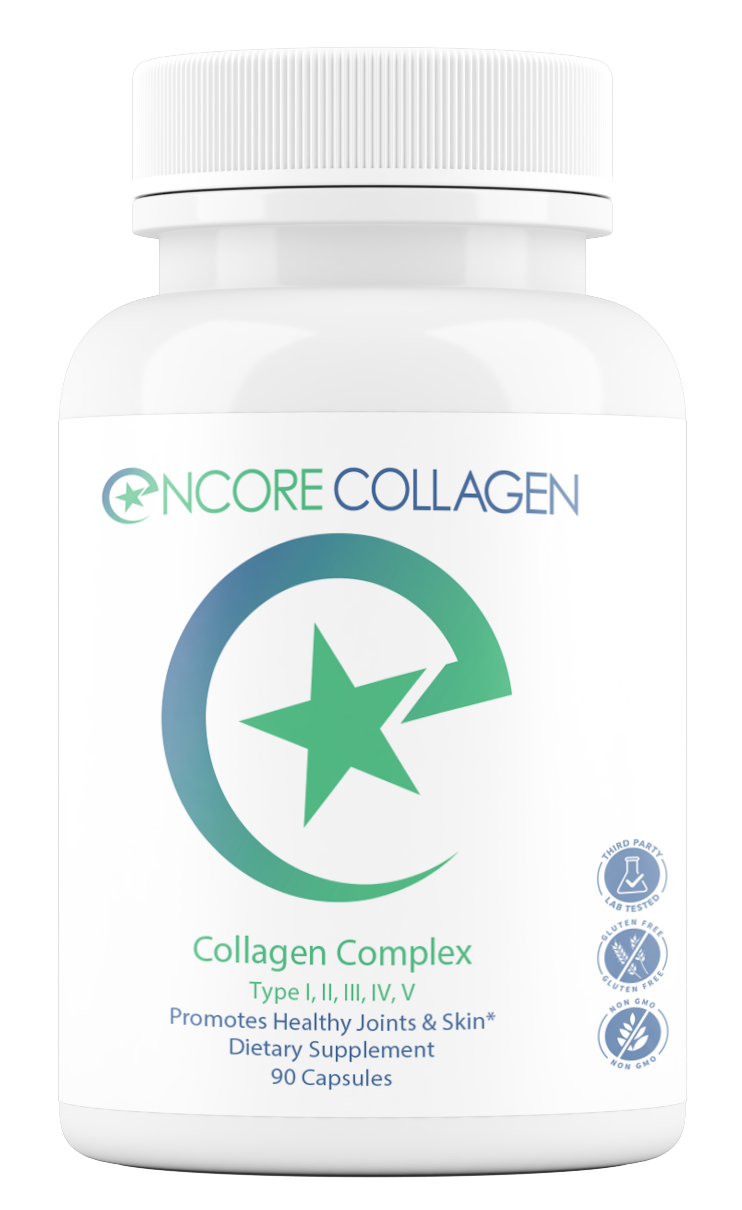
Encore Collagen Complex delivers Types I, II, III, IV, and V from five different sources — including the avian sternum and eggshell membrane where Type V is most concentrated.
Order the Complex →Type V is the dominant structural collagen in hair follicles. The follicle itself is built around a sheath of Type V that anchors the hair shaft and surrounds the dermal papilla — the cluster of cells that signal new hair growth.
When Type V production declines with age, hair follicles thin out, lose their anchor, and shed more easily. This is why supplementing multiple collagen types tends to outperform a single-source product for hair regrowth — the follicle needs Type V specifically, and most single-source bovine or marine collagens contain almost none.
It's also why the visible part of hair benefits indirectly. The shaft itself isn't built from collagen, but the follicle that produces it is. Healthier follicles produce thicker, stronger shafts. The "shinier hair" effect that people report on multi-type collagen has its root in Type V.
Type V also shows up in two places that don't get much air time. The placenta — Type V is essential for the structural integrity of pregnancy tissue. And the cornea — the transparent front of your eye gets its precise optical properties because Type V keeps the collagen fibers there spaced uniformly. If those fibers drift even slightly out of alignment, the cornea loses clarity. Type V is the spacer.
The lesson from these tissues is consistent: Type V controls geometry. Wherever the body needs precision in how collagen lays down, Type V is there doing the organizing work.
Sourcing is the issue. Type V is found in small amounts inside connective tissue, and the richest sources are avian sternum cartilage and eggshell membrane — ingredients that don't appear in mainstream collagen powders. Bovine hide and marine collagen, the two most common sources on the market, contain mostly Type I with trace Type III. They deliver no meaningful Type V.
This is why a "complete" collagen complex requires multiple sources. To get all five types in usable amounts, you need bovine for Types I and III, chicken or avian sternum for Type II, marine cod for additional Type I and IV, and eggshell membrane for the Type V along with hyaluronic acid and other connective tissue cofactors. A single-source supplement, no matter how high the dose, cannot deliver this profile.
Encore Collagen Complex sources Type V from avian sternum and eggshell membrane — the two ingredients with the highest concentration of this rare collagen type. Combined with Types I-IV from four other sources for full-spectrum support.
Type V isn't a headline collagen. You won't see it on a billboard. But it's the quiet organizing protein your body uses to make sure all the other collagens form properly. Without enough Type V, the abundant Type I and Type III fibers in your skin, hair, and bones grow disorganized — and the visible result is thinner hair, weaker connective tissue, and structures that don't hold together the way they used to.
If your collagen supplement only contains Type I, you're missing the protein that tells Type I how to lay down. A multi-source complex that includes avian sternum and eggshell membrane is how you actually deliver Type V to the body. That's the difference between feeding the construction crew and giving them the blueprint.
Type V collagen acts as the structural template that organizes Types I and III into proper fibers. Its benefits include healthier hair follicles, stronger placental tissue, better bone matrix organization, healthier corneas, and properly structured skin. Without enough Type V, the other collagens form irregular, weaker fibers.
Type V collagen is found in hair, the cell surfaces of skin, bone matrix, placental tissue, corneas of the eyes, and the interior of internal organs. It is typically present in small amounts compared to Type I, but it determines the diameter and shape of the fibers those larger types form.
Type V is harder to source than Types I and III. It is found in small concentrations in connective tissue and is most efficiently extracted from sources like avian sternum and eggshell membrane. Single-source bovine and marine collagen supplements typically do not contain meaningful amounts of Type V, which is why multi-source formulas matter for people who want all five types.
1,800mg of five-source collagen per serving. Third party tested. GMP certified. 90-day money-back guarantee.
Order the Collagen Complex →