Joint Health
Glucosamine vs. Chondroitin: What Each One Does and Why They're Paired

Glucosamine vs chondroitin is one of the most searched joint questions out there, and the answer surprises people: they are not competitors. One is a building block. The other is one of the things built from it. That is why you almost always see them sold together.
Here is what each one does, what the biggest trials found, and where collagen fits in.
Glucosamine is an amino sugar your body makes on its own. Its main job is raw material. Cartilage cells use it to build glycosaminoglycans, the long sugar chains that hold water inside cartilage and give joint fluid its slippery texture.
Most supplements use glucosamine from shellfish shells, though shellfish-free versions made by fermentation exist. It comes in two main forms, glucosamine sulfate and glucosamine hydrochloride, and the research on them is not identical. Most trials used about 1,500 mg a day.
Chondroitin sulfate is one of those glycosaminoglycans. It is a finished part of cartilage, not a precursor. Chondroitin chains attach to a large protein called aggrecan, and together they pull water into cartilage like a sponge. That trapped water is what lets cartilage take a load and spring back.
Supplement chondroitin is usually made from bovine, porcine, chicken or shark cartilage. Most studies used 800 to 1,200 mg a day.
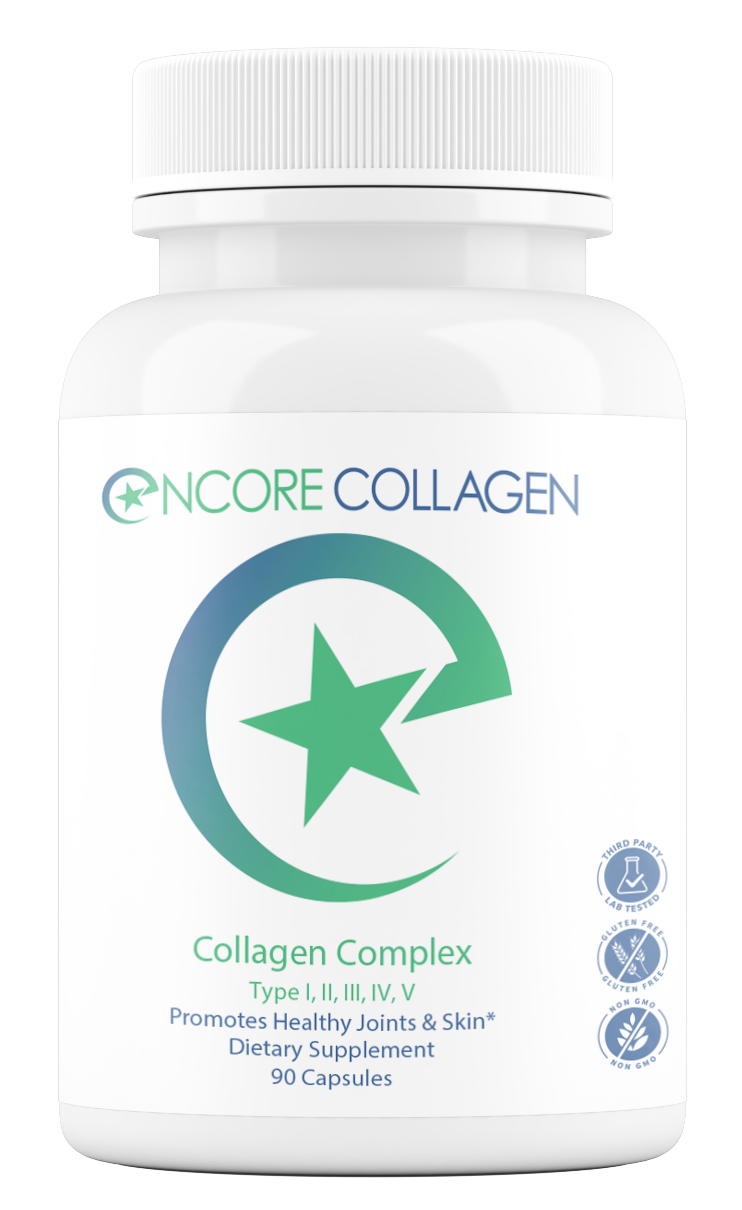
Encore Collagen Complex pairs Type II collagen from chicken and avian sternum cartilage with the glucosamine, chondroitin and hyaluronic acid that cartilage naturally carries, alongside four other collagen sources.
See the FormulaThe largest test was the GAIT trial, published in the New England Journal of Medicine in 2006. About 1,580 people with knee osteoarthritis took glucosamine, chondroitin, both, a prescription anti-inflammatory, or a placebo for 24 weeks.
Overall, neither supplement beat placebo by a meaningful margin. Part of the reason: the placebo group improved a lot on its own, which is common in joint studies. In a smaller group with moderate-to-severe pain, the combination looked better (79% responded vs 54% on placebo), but that group was too small to settle the question.
The MOVES trial (2016) went a step further. In about 600 people with painful knee osteoarthritis, the glucosamine-chondroitin combination performed about as well as celecoxib, a prescription drug, over six months. There was no placebo group, so it can't tell you how much was the supplement itself.
Reviews of chondroitin alone, including a 2015 Cochrane review of 43 trials, found a small short-term improvement in joint comfort, with evidence quality rated low. The honest summary: modest effects, real variation from person to person, and a fair chance you will know within three months whether it does anything for you.
Most people never have to choose. They come as a pair because they work at two steps of the same process: glucosamine supplies the material, chondroitin is the finished part. Most trials tested them at the doses above, so compare labels against those numbers. If you are allergic to shellfish, read the glucosamine source before you buy.
What neither one supplies is the frame itself. Cartilage is a mesh of Type II collagen, and glucosamine and chondroitin are what sit inside that mesh. Our collagen vs glucosamine comparison and our guide to Type II collagen for joints cover that side of the story.
Encore isn't a high-dose glucosamine-chondroitin product. It's a collagen complex. Its avian sternum cartilage brings glucosamine, chondroitin and hyaluronic acid along naturally, inside a 1,800 mg blend built around collagen Types I through V.
The bottom line: glucosamine is the building block, chondroitin is the finished piece, and collagen is the structure they live in. Give any joint routine a steady 8 to 12 weeks before you judge it, and if you have arthritis or take blood thinners, talk to your doctor first.
Glucosamine is an amino sugar that cartilage cells use as raw material to build glycosaminoglycans. Chondroitin sulfate is one of those glycosaminoglycans. It is a finished part of cartilage that helps it hold water and absorb load.
They are usually paired because they work at two steps of the same process. In the GAIT trial, the combination did not beat placebo overall, but it looked better in a small group with moderate-to-severe knee pain. The MOVES trial found the combination performed similarly to celecoxib over six months.
Most trials ran 12 to 24 weeks, and people who notice a difference usually do within the first two to three months. If nothing has changed after about three months of daily use, it is reasonable to reconsider.
1,800mg of five-source collagen per serving. Third party tested. GMP certified. 90-day money-back guarantee.
Order the Collagen Complex →