Joint Health
Collagen vs. Glucosamine vs. Chondroitin: What Actually Works for Joint Pain

Walk down the joint-health aisle and you'll see the same three words repeated on almost every bottle: collagen, glucosamine, chondroitin. They are sold interchangeably. They are not interchangeable.
Each one feeds a different piece of the same tissue. Picking the right one — or more often, the right combination — matters more than the brand on the label. Here is what glucosamine, chondroitin, and collagen each actually do, what the research supports, and how to stack them if your knees, hips, or hands are starting to talk back.
The reason this gets confusing is that cartilage is a composite material. Picture a tangled mesh of collagen fibers (overwhelmingly Type II in articular cartilage) with a thick, water-holding gel packed into the spaces between them. The fibers resist stretching. The gel resists compression. Together they let the knee take 3-5 times your body weight on every step without the two bones grinding on each other.
When cartilage degrades with age, two things happen in parallel: the collagen scaffold frays, and the gel loses its ability to hold water. Glucosamine and chondroitin target the gel. Collagen targets the scaffold. That's the whole argument in one sentence.
Glucosamine is a simple amino sugar — a combination of glucose and glutamine. The body uses it as a raw material to build glycosaminoglycans, the long sugar-protein chains that give cartilage its spongy, water-trapping behavior. Most supplements use glucosamine sulfate; the sulfate form has the more consistent track record in trials than glucosamine hydrochloride.
The research is mixed. The large NIH-funded GAIT trial (2006) found that glucosamine alone performed about the same as placebo for mild knee osteoarthritis, but the combination of glucosamine and chondroitin outperformed placebo in participants with moderate-to-severe pain. European trials using pharmaceutical-grade crystalline glucosamine sulfate have shown stronger results than the over-the-counter forms common in the U.S. Translation: if it works for you, it probably works at 1,500mg/day of the sulfate form, taken daily for at least three months.
Chondroitin sulfate is one of those glycosaminoglycan chains, delivered pre-assembled. If glucosamine is the raw material, chondroitin is the finished component. It's extracted from cartilage — usually bovine trachea or shark — and its proposed benefit is twofold: it may help cartilage hold water, and some trials suggest it mildly dampens the enzymes that break cartilage down.
Chondroitin's independent trial record is weaker than glucosamine's. It shines mostly in combination. The 2016 MOVES trial compared glucosamine-chondroitin to celecoxib (a prescription anti-inflammatory) in moderate-to-severe knee osteoarthritis and found roughly equivalent pain relief at six months — a meaningful finding, given that one carries no cardiovascular risk and the other does.
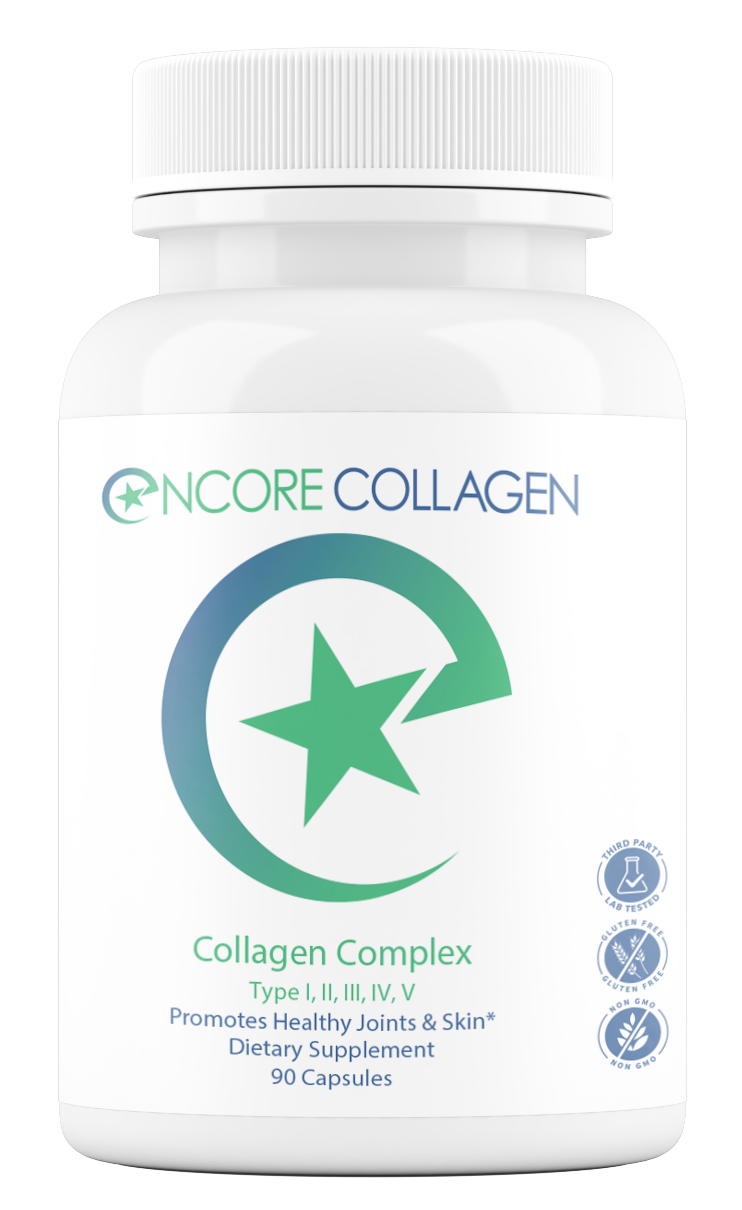
Encore Collagen Complex delivers 1,800mg of Types I, II, III, IV, and V collagen per serving — including the Type II that builds the fiber scaffold inside cartilage.
See the Complex →Collagen is the fiber, not the gel. In articular cartilage, roughly 95% of the collagen is Type II, organized into a dense mesh that gives the tissue its tensile strength. Without the Type II scaffold, the water-holding gel has nothing to anchor to and leaks out under load. This is why cartilage softens and thins before it tears.
The research on undenatured Type II collagen (UC-II) has been the strongest story in joint supplementation over the last fifteen years. A 2016 trial in Nutrition Journal compared 40mg of UC-II to 1,500mg glucosamine + 1,200mg chondroitin in 191 adults with knee osteoarthritis. After 180 days, the UC-II group reported significantly greater reductions in pain, stiffness, and function scores than the glucosamine-chondroitin group. A separate 2022 meta-analysis of UC-II trials in Clinical Rheumatology confirmed the pattern.
Hydrolyzed collagen — the kind in most peptide powders — works by a different mechanism. Instead of training the immune system (UC-II's mechanism), it floods the bloodstream with glycine, proline, and hydroxyproline, the amino acids the body uses to build new collagen fibers anywhere it needs them, cartilage included. A 2008 trial in Current Medical Research and Opinion found that 10g/day of hydrolyzed collagen reduced joint pain in athletes with activity-related knee discomfort. The Type II collagen article goes deeper on the UC-II mechanism.
Four points, from the strongest evidence available.
One. For mild joint stiffness with no diagnosed arthritis, hydrolyzed collagen has the best risk-adjusted case. It's a food protein, it feeds the tissue broadly, and it supports skin, hair, tendons, and bone at the same time. Glucosamine and chondroitin shine when actual osteoarthritic changes are present.
Two. For diagnosed knee osteoarthritis, the single best-studied agent gram-for-gram is 40mg UC-II. It outperforms glucosamine-chondroitin in head-to-head trials, works at a far smaller dose, and has an unusually clean safety profile.
Three. Glucosamine-chondroitin together has stronger evidence than either alone. The combination is cheap, available over the counter, and reasonable for moderate-to-severe knee pain. The collagen vs. glucosamine comparison breaks down the mechanism difference.
Four. The three ingredients are not competing. They are additive. Collagen builds the fiber. Glucosamine-chondroitin builds the gel. The most defensible stack for someone with real joint pain combines them, and the collagen for arthritis breakdown lays out the rationale in more detail.
For general joint maintenance after 40, especially if cartilage isn't visibly compromised on imaging: 10-15g of hydrolyzed multi-type collagen daily, taken any time of day, works well on its own. A multi-type formula is worth the slightly higher cost because cartilage also uses trace amounts of Types IX, XI, and the Type V scaffolding protein.
For diagnosed osteoarthritis — knees, hips, hands, or lumbar facets — add 40mg UC-II (undenatured Type II collagen) and/or 1,500mg glucosamine sulfate + 1,200mg chondroitin sulfate daily. UC-II works through immune tolerance and should be taken on an empty stomach; glucosamine-chondroitin works through substrate supply and can be taken with food. A hydrolyzed multi-type base underneath both of them feeds the broader scaffold.
Give any joint protocol at least 90 days before judging. Cartilage turnover is slow — the Type II collagen in your knee today was built over a span of years, not weeks. You're not looking for a one-week miracle; you're looking for the quiet disappearance of the stair-climb twinge three months from now.
Encore Collagen Complex — 1,800mg of five collagen types from bovine, chicken, marine cod, eggshell membrane, and avian sternum. The Type II scaffold your cartilage is built from, plus Types I, III, IV, and V for connective tissue everywhere else. Third-party tested. 90-day guarantee.
They do different jobs. Glucosamine and chondroitin are building blocks of the gel-like matrix inside cartilage — they help the tissue hold water and resist compression. Collagen is the fiber scaffold that gives cartilage its tensile strength. For osteoarthritis, the most consistent research supports undenatured Type II collagen (UC-II) at 40mg daily, with glucosamine-chondroitin as an inconsistent but reasonable add-on. The GAIT trial found glucosamine-chondroitin worked meaningfully only in people with moderate-to-severe knee pain, not mild cases.
Yes, and it's actually the most defensible stack for cartilage. They target different parts of the same tissue — collagen feeds the fibers, glucosamine feeds the matrix those fibers sit in. There are no known interactions. Chondroitin can be added, though its independent effect is weaker in trials. Many clinical protocols for knee osteoarthritis combine Type II collagen with glucosamine; the two have additive, not competing, mechanisms.
Glucosamine is a simple amino sugar the body uses to build glycosaminoglycans — long chains that trap water inside cartilage. Chondroitin is one of those chains, delivered pre-assembled. Glucosamine is a raw material; chondroitin is a finished product. In practice, glucosamine sulfate shows slightly more consistent trial results than chondroitin alone, which is why most joint formulas combine the two. Neither builds the collagen fibers that give cartilage its strength.
1,800mg of five-source collagen per serving. Third party tested. GMP certified. 90-day money-back guarantee.
Order the Collagen Complex →