Skin & Aging
Dark Circles Under Eyes: Could Collagen Help?

The skin under your eyes is the thinnest on your body. In most places you're working with about 2 millimeters of dermis. Under your eyes, it's closer to 0.5 millimeters — a quarter as thick, no insulating fat pad, and a dense network of fine blood vessels sitting almost directly under the surface.
That's the real reason dark circles get worse with age. Sleep and stress play a part, but a big driver is that the already-thin dermis keeps losing collagen with age, and as it thins further, the blood vessels underneath start to show through.
So the question isn't whether collagen for dark circles is a myth. The question is: which kind of dark circles respond, and how fast.
Dermatologists classify under-eye darkness into three categories. Knowing which one you have determines what will actually move the needle.
Pigmented circles are a brown or grey discoloration caused by melanin — common in darker skin tones, often genetic, worsened by sun exposure. These respond to pigment-targeting ingredients (vitamin C, niacinamide, kojic acid) and sunscreen, not collagen.
Structural circles are the hollow shadow created by a deep tear trough. This is anatomy — a loss of orbital fat and bone remodeling. Supplements don't change it; it's a conversation for a dermatologist.
Vascular circles are the blue, purple, or pinkish darkness that comes from blood vessels showing through translucent skin. This is the type that worsens dramatically with age, and this is the type where skin quality matters most — thicker, firmer skin over the vessels makes them less visible.
If you pull the skin taut and the darkness fades, you're looking at vascular circles. If it stays, it's pigment or structure. Most people over 40 have vascular circles as the dominant layer, often stacked on top of a little of each other type.
From age 25 onward, you lose roughly 1-1.5% of your total collagen per year. But under-eye skin accelerates faster for three specific reasons.
First, it starts thinner. The baseline is a quarter the thickness of cheek skin, so every percent lost is visually louder.
Second, it moves constantly. You blink thousands of times a day, and that constant motion puts repeated stress on thin skin and its elastin fibers.
Third, UV exposure hits it hard. The orbital area is exposed, often missed by sunscreen application, and photoaging degrades Type I collagen faster than natural aging does.
Over the decades, that adds up. The capillary network underneath hasn't moved. It's just more visible.
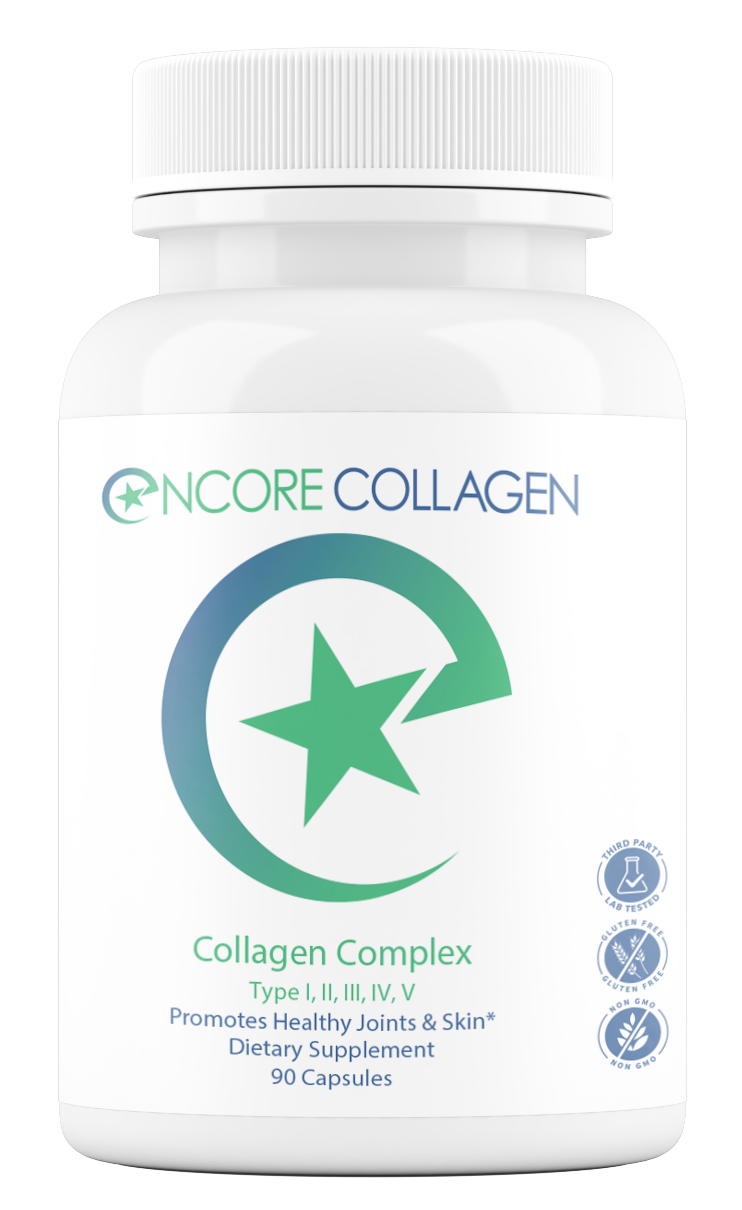
Encore Collagen Complex delivers 1,800mg of hydrolyzed collagen from five sources, covering Types I through V, in one three-capsule serving to support the skin's collagen network.
Order Encore Collagen →You can't selectively supplement the skin under your eyes. But you can rebuild the collagen scaffold across your whole dermis, and under-eye skin benefits because it's part of that same system.
A 2019 systematic review in the Journal of Drugs in Dermatology looked at 11 studies of oral collagen and reported promising results for skin elasticity, hydration, and dermal collagen density, with most trials running 8-12 weeks of daily use. Dermal density is the metric that matters for vascular dark circles — the thicker the dermis, the less visible the vessels underneath.
A separate 2014 trial in Skin Pharmacology and Physiology gave women 2.5g of specific collagen peptides daily and measured reduced eye wrinkle volume after 8 weeks, along with a 65% rise in procollagen Type I in skin samples. That suggests the peptides do more than pass through.
None of these trials studied under-eye skin in isolation. But under-eye skin is dermis, and the dermis responded.
When people talk about collagen for skin, they almost always mean Type I and Type III — the structural proteins. But under-eye skin has a specific weak point most skincare content ignores: the basement membrane.
The basement membrane is the thin layer that glues your epidermis to your dermis. It's made almost entirely of Type IV collagen. When Type IV breaks down with age, the epidermis loses some of its structural anchorage. The skin starts to look crepey, loose, and slightly transparent. That transparency is a big part of what makes under-eye vessels pop.
Most single-source supplements come from hide or fish skin (Types I and III, or Type I). A multi-source formula that adds eggshell membrane and cartilage sources draws on a wider range of collagen types. Hydrolyzed collagen is broken into peptides during digestion either way, so think of this as broader raw material, not a direct delivery to the basement membrane.
Collagen is a slow fix. The protein takes weeks to be synthesized, deposited, and crosslinked into functional dermis. The published trials are consistent: 8 weeks for measurable change, 12 weeks for visible change in many studies.
If you've been taking collagen for 3 weeks and don't see your dark circles change, that's expected. Keep going. If you've been taking it for 4 months and nothing moved, there's a good chance your circles are pigment or structure, not vascular — and a different intervention is required.
Topical caffeine serums, cold compresses, and sleeping with your head elevated can produce short-term reduction in puffiness and vascular dilation. They don't change the underlying skin, which is where months of consistent collagen support come in.
Collagen works best as the base layer of a longer strategy. Three additions support it under the eyes.
Daily broad-spectrum sunscreen — especially around the orbital area — stops the main driver of future collagen breakdown. SPF 30+ applied to the whole face every morning. The under-eye zone is the most-missed spot in the entire face, which is why it ages faster even in people who are otherwise diligent with sun protection.
A topical retinoid or retinol at night thickens the epidermis and stimulates dermal collagen production from the outside. Pair with oral collagen and you're building from both directions.
Vitamin C, both oral and topical, is a required cofactor for collagen synthesis. Your body literally cannot build new collagen without it. Citrus, berries, peppers and leafy greens cover most people's needs; a basic C supplement fills any gap.
Keep Reading
Encore Collagen Complex gives you Types I, II, III, IV, and V in one serving — including eggshell membrane, a source most single-source formulas don't use.
Collagen can't erase dark circles caused by pigmentation or deep tear-trough shadows, but it supports the skin over vascular darkness that comes from thin, translucent skin. Hydrolyzed collagen trials have reported gains in dermal density after 8-12 weeks — a thicker dermis helps hide the blue-purple capillary network that creates most under-eye darkness in adults.
Dermal collagen remodeling is slow. Published trials consistently show visible improvement in skin thickness and elasticity at the 8-week mark, with continued gains through 12 weeks. For under-eye skin specifically — which is the thinnest on your body — expect to need the full 12 weeks of daily use before judging the result.
Under-eye skin needs both Type I (the structural scaffold) and Type III (the elastic, youthful dermis). Type IV is also critical — it builds the basement membrane that anchors the epidermis to the dermis. A multi-source hydrolyzed collagen draws on sources for all three; once digested, any hydrolyzed collagen supplies peptides and amino acids.
1,800mg of five-source collagen per serving. Third party tested. GMP certified. 90-day money-back guarantee.
Order the Collagen Complex →