Joint Health
How Collagen Supports Joint Health After 40

That morning stiffness you feel in your knees, hips, or hands? It's not just "getting older." It's your body telling you that the cartilage cushioning your joints is thinning — and the protein responsible for maintaining it has been declining for years.
That protein is collagen. Specifically, Type II collagen — the primary structural component of cartilage tissue. And after 40, you've already lost roughly 20% of what you had at your peak.
Cartilage is the smooth, rubbery tissue that covers the ends of bones where they meet at joints. It absorbs shock, reduces friction, and allows smooth movement. Type II collagen makes up 50-60% of all protein in cartilage.
When Type II collagen depletes, cartilage thins. Bones get closer together. Friction increases. The result is stiffness, discomfort, and reduced range of motion — especially first thing in the morning or after sitting for long periods.
Here's what most people miss: bovine collagen — the most common type in supplements — doesn't contain Type II. It delivers Types I and III, which support skin and tendons. Your joints never see a benefit.
Walk into any supplement aisle and you'll find dozens of collagen products. The vast majority are single-source bovine or marine collagen. Both are legitimate for skin support. Neither one contains the Type II collagen your cartilage needs.
Type II collagen can only be reliably sourced from chicken collagen and avian sternum cartilage. These are the clinically studied sources for joint health — and they're missing from most products on the shelf.
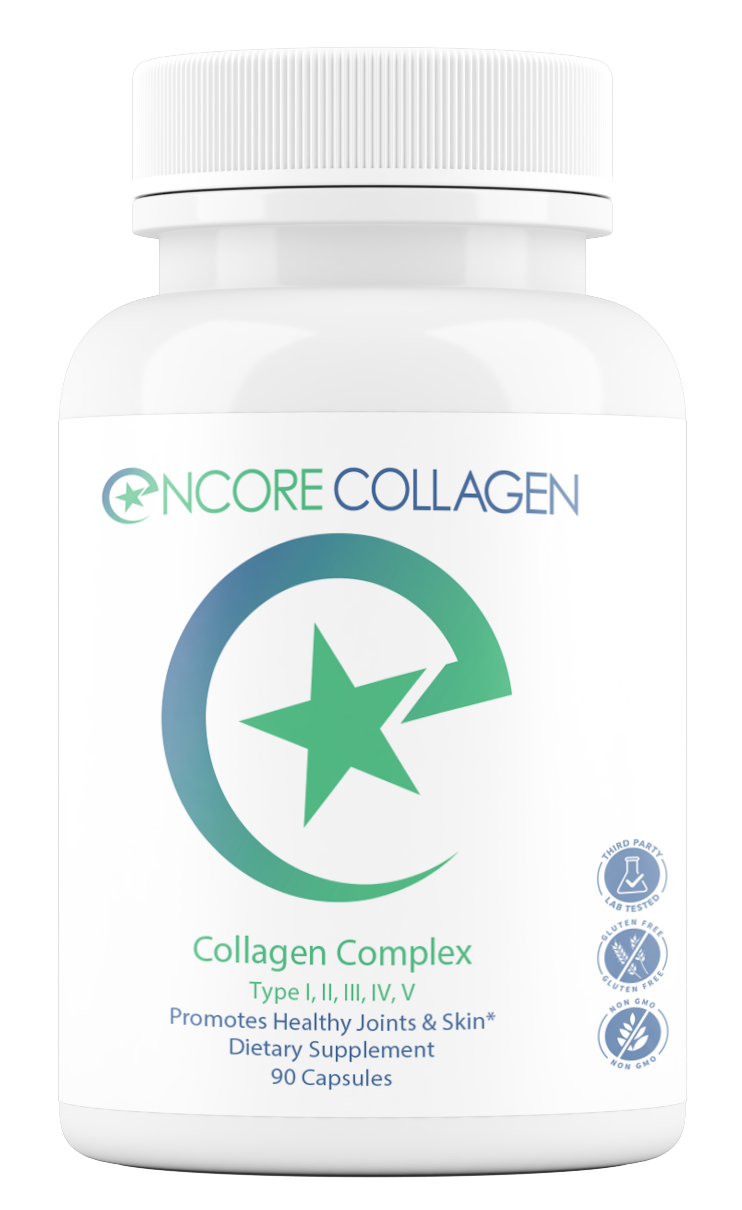
Encore Collagen Complex includes both chicken and avian sternum collagen — two dedicated Type II sources for comprehensive joint support.
Try Encore Collagen — 90-Day Guarantee →Avian sternum collagen deserves special attention. Beyond delivering Type II collagen, it naturally carries three additional compounds critical for joint function: Glucosamine, Chondroitin, and Hyaluronic Acid.
These are the components of synovial fluid — the lubricant that keeps your joints moving smoothly. Most people buy Glucosamine and Chondroitin as separate supplements. With avian sternum collagen, they come built in.
Clinical studies on Type II collagen supplementation consistently show improvements in joint comfort and mobility within 8-12 weeks. The mechanism is straightforward: you're providing the raw material your body needs to maintain and repair cartilage tissue.
The key variable is consistency. Collagen supplementation isn't a quick fix — it's a rebuilding process. Your body uses the collagen peptides to support ongoing cartilage maintenance, and the effects compound over time.
Encore Collagen Complex delivers 1,800mg of five-source collagen daily — including two dedicated Type II sources for joints, plus Types I, III, IV, and V for skin, tendons, and cellular repair.
Type II collagen is the primary structural protein in cartilage. Supplementing with Type II collagen supports cartilage maintenance and joint cushioning, which can reduce stiffness and discomfort over time.
Most people notice improvements in joint comfort between 8 and 12 weeks of consistent daily supplementation.
Type II collagen, sourced from chicken or avian sternum, is the most clinically studied type for joint and cartilage support.
1,800mg of five-source collagen per serving. Third party tested. GMP certified. 90-day money-back guarantee.
Order the Collagen Complex →