Joint Health
Collagen for Tendons: What Research Shows Actually Works

The first time most men over 40 notice a tendon, something has already gone wrong. The Achilles is stiff for the first 50 feet out of bed. The patellar tendon just below the kneecap grumbles when you stand up from a low chair. The shoulder catches on the way to a top shelf. The elbow starts talking to you when you shake hands.
None of that is random. Tendons are up to 80% collagen by dry weight, overwhelmingly Type I, and they operate on one of the slowest repair timelines in the body. When collagen synthesis slows with age — and it starts slowing in your mid-thirties — the tendons feel it before the joints do.
Here's what the research actually says about collagen for tendons, when it works, and the one timing detail most people miss.
A tendon is a dense, highly organized cable of collagen fibers that transmits force from a muscle to a bone. Under a microscope, it looks like a bundle of ropes twisted inside bigger ropes — hierarchical layers of fibrils, fibers, and fascicles, all aligned in the direction of pull. Roughly 80% of a healthy tendon's dry weight is collagen, and about 95% of that collagen is Type I.
The remaining collagen is a mix — small amounts of Type III (concentrated during healing and in newer tissue), plus trace Types V and VI that organize the fibril diameter. Type I is the load-bearing scaffold. When you tear a tendon, the first repair wave is mostly Type III — weaker, more pliable, laid down fast — and the body then slowly remodels it into Type I over months. That's why a healed tendon is often not quite as strong as it was before the injury, and why the remodeling phase takes so long.
Three reasons. First, tendons have poor vascular supply — they don't get the nutrient-rich blood flow that muscle does. Nutrients diffuse in. Waste diffuses out. It's slow.
Second, tendon cells (tenocytes) are sparse and metabolically quiet compared to the fibroblasts in skin or the chondrocytes in cartilage. They respond to mechanical load, but they don't crank out new collagen the way skin cells do.
Third, the amino acid pool limits it. Tendon collagen is unusually rich in glycine, proline, and hydroxyproline. Muscle meat and whey contain them, but in much smaller proportions than collagen does. The richest sources are the parts of animals most people don't eat anymore: skin, cartilage, bone broth, and the connective tissue trimmed off before packaging. That's exactly what hydrolyzed collagen provides — in pre-digested peptide form that the gut absorbs easily.
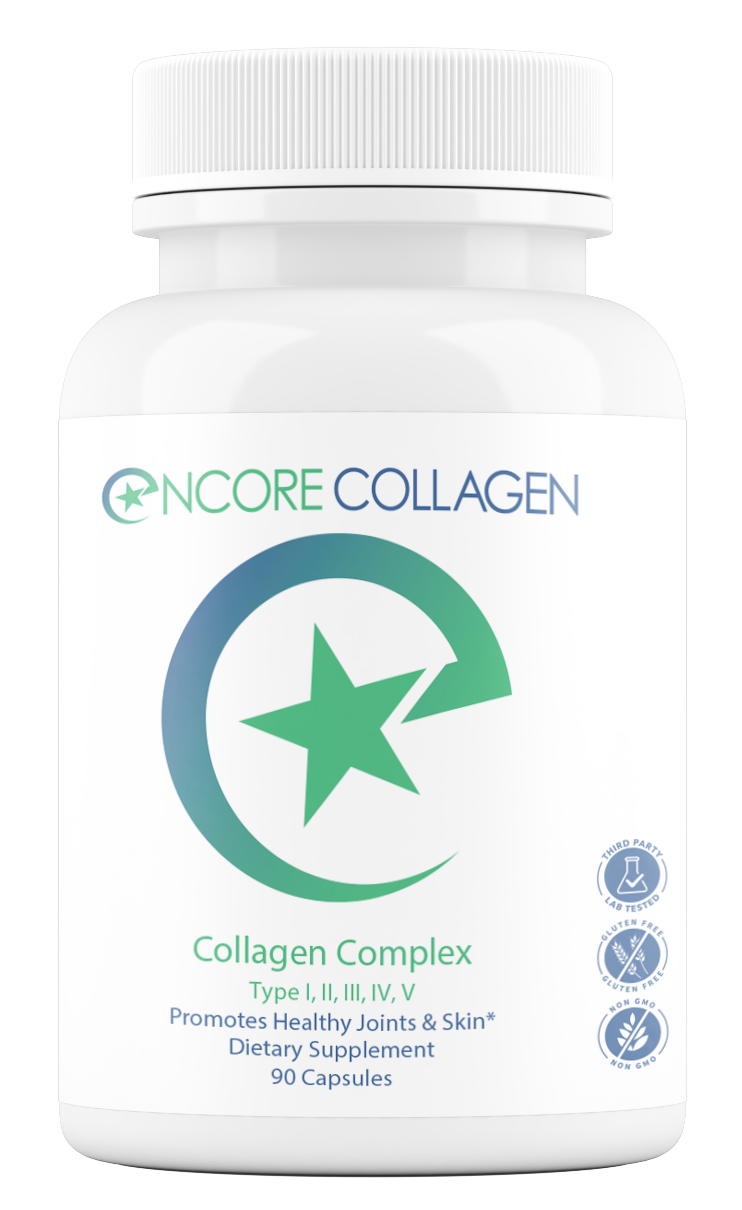
Encore Collagen Complex delivers 1,800mg of Types I, II, III, IV, and V collagen per serving — including the Type I and Type III your tendons are built from.
See the Complex →In 2017, a research team led by Keith Baar at UC Davis published a study in the American Journal of Clinical Nutrition that changed how sports medicine thinks about collagen and tendons. Eight healthy young men took a placebo, 5g, or 15g of gelatin enriched with about 50mg of vitamin C, then did six minutes of jumping rope — a brief tendon-loading exercise — one hour later.
With 15g, a blood marker of collagen synthesis roughly doubled compared with placebo, while 5g produced a smaller rise. It was a small study and it measured whole-body collagen production, not one tendon directly, but it gave researchers a clear protocol to test further.
The proposed mechanism is simple. Tendons pull nutrients in by diffusion. When you load them briefly, blood flow to the tendon increases. If the amino acids are circulating in your bloodstream at that moment, they get pulled into the tendon right when the tendon is signaling for repair. Timing isn't magic — it's just logistics.
The study protocol: 15g of gelatin with vitamin C, about an hour before a short loading session. Most daily collagen supplements, including capsule formulas, provide far less than that, so treat 15g as the research dose, not a requirement. The loading can be as simple as a brisk walk, a flight of stairs, a brief strength circuit, or five minutes of jumping. You don't need to destroy yourself. You just need the tendon to notice.
Type I does the heavy lifting — it's the scaffold. Type III matters most during active repair, which is why multi-type formulas are worth it if a specific tendon is already injured or chronically irritated. Type V in trace amounts helps organize the fibril diameter, and under-organized fibrils are one of the structural problems in chronic tendinopathy. The Type III elasticity protein matters especially in early healing.
A single-source marine or bovine collagen gives you mostly Type I, which is useful but incomplete. A multi-type formula gives you the full set the tendon actually uses across its repair cycle. For the same reasons athletes need multi-type collagen to protect joints under stress, anyone working through tendon discomfort benefits from the broader scaffold.
Topical collagen creams don't reach tendon tissue. The molecule is too large to penetrate skin, and even if it could, tendons sit under layers of fascia and sometimes bone. Any benefit from a topical is moisturization of the skin above the tendon, not repair.
Stretching an irritated tendon aggressively can make it worse. Tendons respond to progressive load, not to being yanked. Eccentric loading — slow lowering under weight — is what the research supports for Achilles, patellar, and elbow tendinopathy. A physical therapist can set the right program for you. In one 2019 trial in people with Achilles tendinopathy, adding collagen peptides to a calf-strengthening program improved symptoms more than the same program with a placebo over the first three months.
Anti-inflammatories blunt the repair signal. They feel good short-term because they reduce pain, but some research suggests prolonged NSAID use during tendon rebuilding may slow collagen synthesis. If you rely on them, talk to your doctor about how long to use them.
Tendons don't do dramatic. The UC Davis synthesis spike is measurable in a single session, but a sore Achilles, patellar tendon, or shoulder cuff needs that synthesis to compound over months before you feel the difference. Give daily collagen plus smart loading a steady three to six months before you judge it.
Encore Collagen Complex — 1,800mg of five collagen types from bovine, chicken, marine cod, eggshell membrane, and avian sternum. The Type I, III, and V scaffold your tendons rebuild from. Third-party tested. 90-day guarantee.
The early research is promising. Tendons are roughly 80% collagen by dry weight, and collagen supplies the glycine and proline they are built from. A small UC Davis study in the American Journal of Clinical Nutrition found that 15g of vitamin C-enriched gelatin taken an hour before a brief loading exercise doubled a blood marker of collagen synthesis compared with placebo.
The study that tested timing gave it about an hour before a short loading session — in that case, six minutes of jumping rope. A walk or a brief strength workout follows the same idea. The exercise sends blood to the tendons (which are otherwise poorly vascularized), and the amino acids from the collagen are delivered right when the tendon is actively rebuilding. This window is why timing matters for tendon work in a way it doesn't for skin or hair.
Tendons rebuild on a slow timeline — expect 3 to 6 months of daily use before judging. The UC Davis synthesis effect is measurable in a single session, but functional improvement in a painful Achilles, patellar tendon, or rotator cuff requires that synthesis to compound over months. Tendons aren't dramatic. They're slow.
1,800mg of five-source collagen per serving. Third party tested. GMP certified. 90-day money-back guarantee.
Order the Collagen Complex →