Joint Health
Collagen for Athletes: Protecting Joints Under Stress

If you train hard, you already know what your knees, ankles, and shoulders feel like the morning after a heavy session. That stiffness isn't random — it's your connective tissue trying to repair faster than it can rebuild. Push it long enough and the math stops working.
Athletes obsess over protein, creatine, electrolytes. Almost nobody talks about the supplement built for the parts of your body that take the actual beating: the cartilage, the tendons, the ligaments. That's where collagen comes in — and the data on it is stronger than most people realize.
Every time you run, lift, jump, or change direction under load, the cartilage in your weight-bearing joints compresses. Tendons stretch. Ligaments absorb impact. These tissues are made almost entirely of Type I and Type II collagen — and they rebuild far slower than muscle does.
Muscle protein synthesis peaks within hours of training. Collagen synthesis in cartilage and tendon takes days to fully respond to a stimulus. That's the gap most athletes don't account for. You can recover your quads in 48 hours but the knee joint underneath them is still rebuilding for a week.
When the rebuild can't keep up, the tissue starts to thin. Cartilage erodes. Tendons develop micro-tears. Ligaments lose tensile strength. This is the underlying mechanism behind almost every overuse injury in sport — and the slow drift toward chronic joint pain in former athletes who stopped training.
A study from the American Journal of Clinical Nutrition tested a simple protocol: 15g of collagen peptides with 50mg of vitamin C, taken one hour before training. The collagen synthesis rate in the trained subjects' connective tissue doubled compared to placebo. The timing window matters — collagen has to be in the bloodstream when blood flow to connective tissue peaks.
Subsequent research has refined the dosing. The minimum effective dose for athletic recovery sits around 10g per day. Most clinical trials use 15-20g. The vitamin C cofactor isn't optional — it's required for the enzymatic conversion of proline to hydroxyproline, which is what gives collagen its tensile strength.
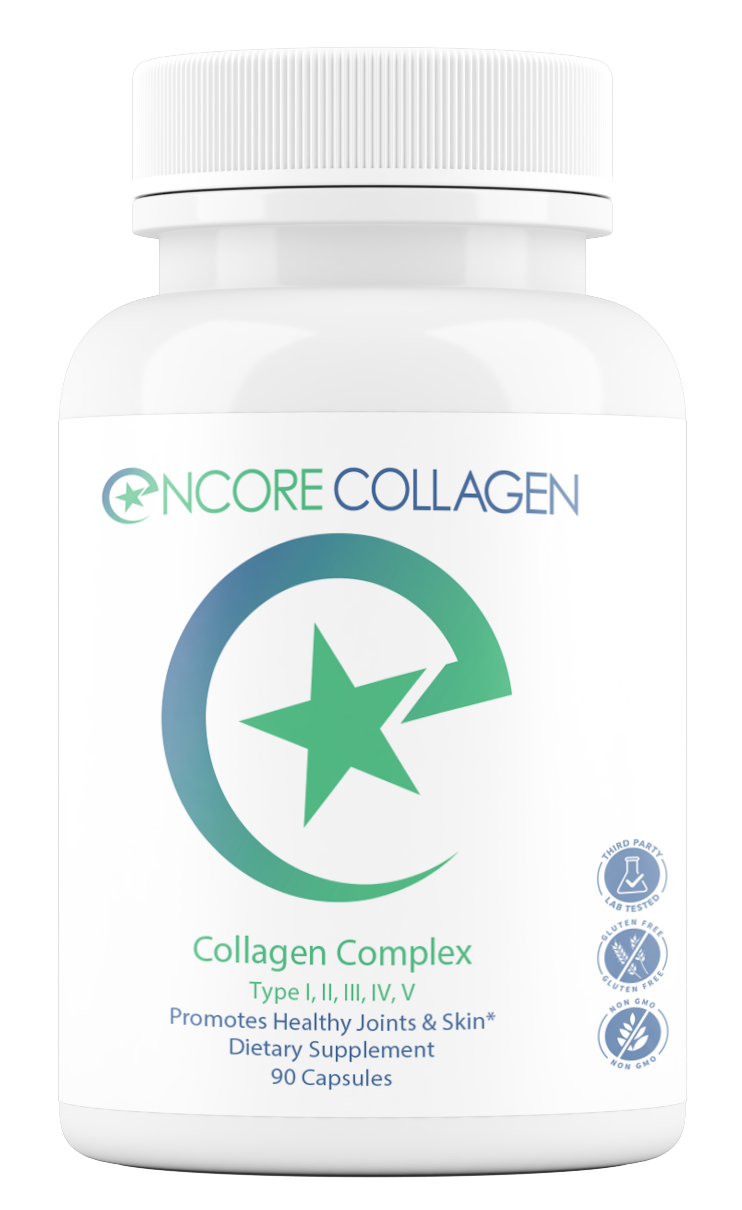
Encore Collagen Complex delivers 1,800mg of multi-source peptides per serving — Types I, II, III, IV, and V. Built for connective tissue, not just skin.
Order the Complex →If you only train for general fitness, multi-type collagen serves you well across the board. If you train at high intensity — running, contact sport, repetitive impact — Type II collagen specifically matters because it's the structural protein of articular cartilage, the smooth load-bearing surface inside your weight-bearing joints.
The Harvard Medical School studies on undenatured Type II collagen (UC-II) showed that even small daily doses (40mg) improved joint comfort and range of motion in active subjects, with results comparable to or better than 1,500mg of glucosamine. The mechanism is different from hydrolyzed collagen — UC-II works through immune tolerance rather than raw material supply — but the outcome converges: less joint pain, better function.
The best protocol combines both. Hydrolyzed peptides give your body the building blocks. UC-II calibrates the immune response. Multi-source complexes that include both are doing what a single-source supplement can't.
A 24-week study on athletes supplementing 10g of collagen daily found measurable reductions in joint pain at the end of training cycles, faster return to baseline soreness, and fewer self-reported soft-tissue injuries compared to controls. The athletes weren't training less — they were tolerating training more.
This is the part that compounds over a season or a career. Most athletes don't quit a sport because they can't perform; they quit because the cumulative joint damage makes it not worth it anymore. Protecting connective tissue is what keeps the body in the game past 35, past 45, past 55.
Three things separate effective athletic collagen from generic wellness collagen:
Multiple types — not just Type I. Skin-targeted collagen products focus on Type I. Athletes need Types I, II, III, and V at minimum. Type II for cartilage. Type III for blood vessel and connective tissue elasticity. Type V for the structural framework that holds the others together.
Hydrolyzed peptides. Whole protein collagen has to be broken down by the body before absorption. Hydrolyzed peptides are pre-cleaved into shorter chains that absorb faster — which matters when timing the dose around training.
Third-party tested. Sport-tested certification matters if you compete. Untested supplements can contain trace banned substances. Look for NSF Certified for Sport or Informed-Sport markings, or a third-party lab certificate from the manufacturer.
Encore Collagen Complex delivers Types I-V from bovine, chicken, marine cod, eggshell membrane, and avian sternum. Hydrolyzed peptides. Third-party tested. GMP certified. Built for connective tissue recovery — not just skin.
If you train and you're not supplementing collagen, you're letting your joints rebuild on whatever amino acids happen to be left over from your diet. That's enough for sedentary recovery. It's not enough for athletic stress. The cumulative gap between breakdown and repair is what eventually puts athletes on the sidelines.
10-15g of multi-source collagen daily, taken with vitamin C, ideally 30-60 minutes before training. That's the protocol the research supports. It won't make you faster. It will keep your joints capable of training hard, week after week, year after year.
Yes. Multiple controlled studies show that 10-15g of collagen peptides taken 30-60 minutes before training increases collagen synthesis in connective tissue by up to 2x. Athletes report less joint stiffness, faster recovery, and lower injury rates with consistent daily supplementation over 12+ weeks.
Whey and other muscle proteins target skeletal muscle. Collagen targets connective tissue — cartilage, tendons, ligaments — which whey does not feed efficiently. For athletes, the two are complementary: muscle protein for performance, collagen for the joints and tendons that have to keep up with the muscle.
Research from the University of California found that taking collagen 30-60 minutes before training, ideally with vitamin C, produced the highest collagen synthesis response. Daily timing matters less than daily consistency. The minimum effective dose for athletic recovery is around 10g per day.
1,800mg of five-source collagen per serving. Third party tested. GMP certified. 90-day money-back guarantee.
Order the Collagen Complex →