Joint Health
Collagen for Runners: Protecting Cartilage Mile After Mile
A runner lands with roughly two to three times their body weight on a single knee. Do that 1,500 times per mile, 20 miles a week, 50 weeks a year, and you start to understand why the cartilage in a lifelong runner's knee looks different from the cartilage in someone who sits at a desk.
That doesn't mean running destroys joints — the opposite, usually. Loading signals cartilage to maintain itself. But the signal only works if the body has the raw material to answer it. That raw material is collagen. And after about age 30, the supply starts falling behind the demand every mile puts on it.
Three structures carry the brunt of every stride. Articular cartilage — the glassy white tissue on the ends of the femur and tibia — is almost entirely Type II collagen woven with proteoglycans. The patellar tendon and Achilles tendon are dense Type I collagen rope. The menisci, the two crescent-shaped shock absorbers inside each knee, are a mix of Type I and Type II.
Impact doesn't tear these structures all at once. It micro-damages them, cycle by cycle. In a young runner, repair outpaces damage. The collagen scaffold is laid down fresh overnight. By 35, the repair rate has slowed. By 45, it has slowed again. The miles don't change — the body's ability to rebuild what each mile costs does.
This is where collagen for runners differs from collagen for almost anyone else. A 2017 study from researchers at UC Davis and the Australian Institute of Sport, published in The American Journal of Clinical Nutrition, found that taking 15g of vitamin C-enriched gelatin 60 minutes before a short bout of jumping exercise roughly doubled a blood marker of collagen synthesis over the following hours.
Translation: the amino acids need to be in your bloodstream when the tendon and cartilage are being stressed. That's when the repair machinery is listening for raw material. Take collagen two hours after a run and it still helps baseline, but you miss the window where loading signals synthesis most aggressively. The protocol for runners is clear — dose before the session, not after.
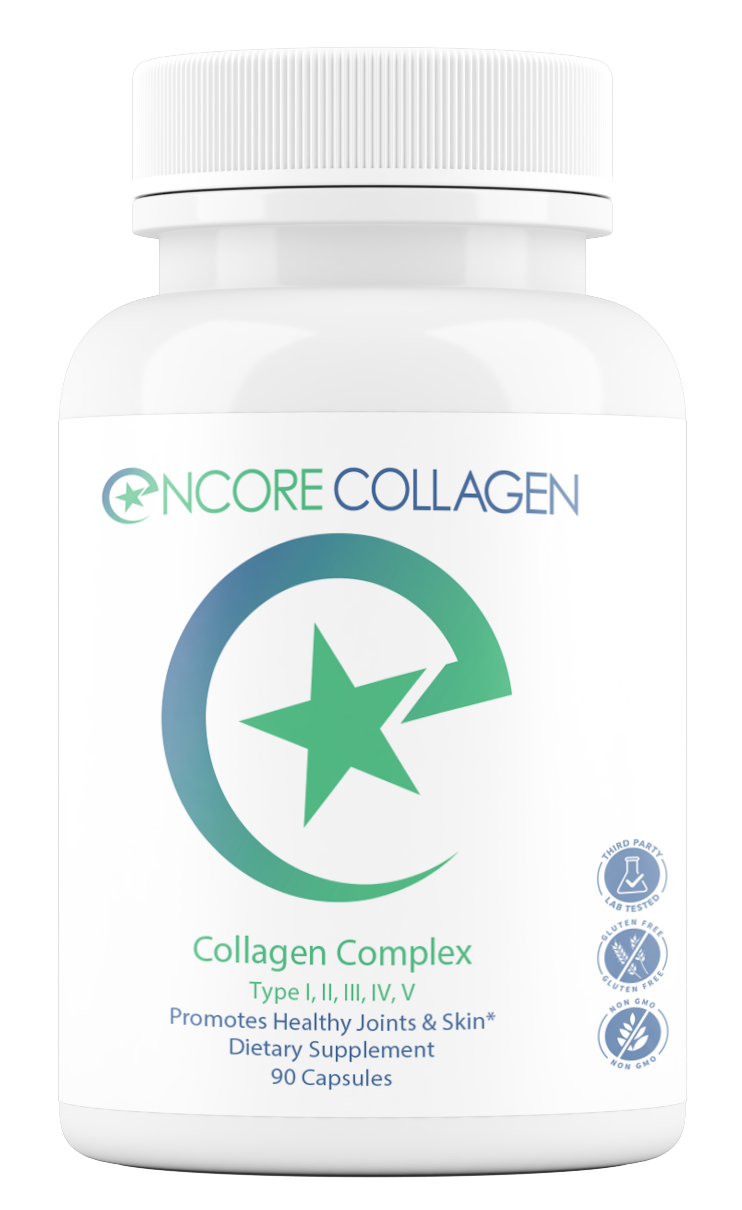
Encore Collagen Complex delivers 1,800mg of Types I, II, III, IV, and V — the exact collagen that builds tendon, cartilage, and the meniscus of a running knee.
See the Complex →A single-source collagen only feeds part of the system. Marine collagen is mostly Type I — it supports tendon and skin, but it doesn't reach the cartilage surface. Bovine is Type I and III. Neither delivers meaningful Type II, which is the specific collagen that builds articular cartilage and the inner knee meniscus. That's the reason Type II collagen is the one most supplements quietly leave out — it's harder to source. For a runner, that's the type that matters most.
A multi-type formula covers all three structures at once: Type I for the Achilles and patellar tendon, Type II for the cartilage and meniscus, Type III for the connective tissue around the hip and knee capsule. Running loads all three. So should the supplement.
Four things make the difference. And the common mistakes that cancel the benefit.
Dose before the session. 10 to 15g of hydrolyzed collagen with 50mg of vitamin C, 45 to 60 minutes before the run. Vitamin C is a required cofactor for collagen synthesis — without it, the glycine and proline sit in the bloodstream unused.
Daily consistency, not just on run days. Cartilage turns over slowly. The amino acid pool needs to stay elevated between runs, not spike and drop. Daily dosing — including rest days — keeps the material available for overnight rebuild.
Load progressively. Collagen synthesis is driven by mechanical stimulus. Runners who ramp mileage too fast outrun the repair rate; runners who maintain structured, progressive loading give the signal time to work. Add miles the way you'd add weight on a bar.
Protect the sleep window. Most connective tissue repair happens during deep sleep. If you're training hard and sleeping six hours, the ceiling on your recovery is low no matter how much collagen you take. This is the same timeline the body follows across the general collagen decline curve — supply alone doesn't fix a schedule the body can't recover from.
What doesn't work: Taking collagen only on hard-run days. Taking it after instead of before. Pairing it with a 20-minute foam roller session and calling that recovery. Skipping the vitamin C.
Clinical work on hydrolyzed collagen in athletes shows measurable reduction in joint pain and improved cartilage markers between 8 and 12 weeks of consistent daily dosing. For a lifelong runner trying to protect miles 15 years ahead, the right mental model is 6 months to feel the floor rise and years to compound it. Cartilage you don't lose at 45 is cartilage you still have at 55.
The runners who stay in the sport past 50 and 60 — the ones you see at trailheads with gray hair and functional knees — tend to share two habits. They sleep. And they feed their connective tissue every single day, whether they ran that morning or not.
Encore Collagen Complex — 1,800mg of five collagen types from bovine, chicken, marine cod, eggshell membrane, and avian sternum. The full scaffold your tendons, cartilage, and meniscus are built from. Third-party tested. 90-day guarantee.
Yes, with a specific protocol. A 2017 study from UC Davis and the Australian Institute of Sport found that 15g of vitamin C-enriched gelatin taken 60 minutes before loading exercise roughly doubled a blood marker of collagen synthesis. For runners, that means more raw material delivered to tendons and cartilage during the exact window they're being stressed by impact.
Before. Research shows that tendon and cartilage pull amino acids from the bloodstream during loading, not after. Taking 10 to 15g of hydrolyzed collagen about 60 minutes before a run puts the glycine, proline and hydroxyproline into circulation at the moment the body is signaling for repair. Add vitamin C to support synthesis.
Collagen supports the tendons, cartilage and ligaments that absorb every stride by supplying the amino acids they are built from. Studies on athletes supplementing hydrolyzed collagen daily show reduced joint pain during activity and faster recovery between sessions. It's not a shortcut around smart training; it's a raw material the body uses to keep up with the mileage.
1,800mg of five-source collagen per serving. Third party tested. GMP certified. 90-day money-back guarantee.
Order the Collagen Complex →