Why Collagen
Does Collagen Help You Sleep? The Glycine Connection

Here is the question that keeps showing up in search data every week: is it better to take collagen at night or in the morning? The short answer most people never get is that collagen and sleep are more connected than the timing debate suggests. If you have been struggling to fall asleep, or waking up at 3 a.m. feeling wired, the amino acid profile of collagen is worth a careful look.
Collagen is a protein, but not just any protein. Roughly one-third of it — about one in every three amino acids — is a single amino acid called glycine. That is unusual. Most dietary proteins contain only 2 to 5% glycine. Collagen is a glycine delivery system, and glycine happens to be one of the most studied sleep-supportive amino acids in human research.
This is why the "collagen at night" questions in search data are not accidental. People are feeling something after they take it before bed, and the mechanism is real.
Glycine does three measurable things that are relevant to sleep.
First, it acts on receptors in the suprachiasmatic nucleus of the hypothalamus — the tiny region of the brain that runs the sleep-wake clock. The result is a modest drop in core body temperature. Your core temperature naturally has to fall by about half a degree Celsius for sleep to initiate; glycine helps that drop happen on time.
Second, glycine behaves as an inhibitory neurotransmitter in the central nervous system. In practical terms, it tells the brain to downshift — the same category of signal that GABA sends. For people whose thoughts speed up at bedtime, this matters.
Third, in clinical sleep-lab studies, 3 grams of glycine taken about an hour before bed reduced the time it took subjects to fall asleep, improved sleep quality scores the next morning, and reduced daytime fatigue — all without the "hangover" grogginess that most sleep aids produce. Glycine makes up roughly a fifth to a quarter of collagen by weight, so it takes a large powder serving - around 12 to 15 grams of collagen peptides - to reach the 3 grams used in those studies.
Here is the sequence. You mix a scoop of hydrolyzed collagen peptides into warm water or a non-caffeinated tea about 45 to 60 minutes before bed. The peptides are already pre-broken into small di- and tri-peptides, so they absorb quickly — no heavy digestion required, no blood sugar spike, nothing that interferes with winding down.
Glycine from the digested peptides enters the bloodstream, and in animal studies oral glycine raises glycine levels in the brain and triggers the drop in core temperature described above. The idea is to time that signal to land as you are winding down.
None of this makes collagen a sedative. It is not. Nothing switches the lights off. What it does is remove a few of the chemical reasons your body might be resisting sleep in the first place — and it does it using an amino acid your body also wants for connective tissue repair while you sleep. You get both.
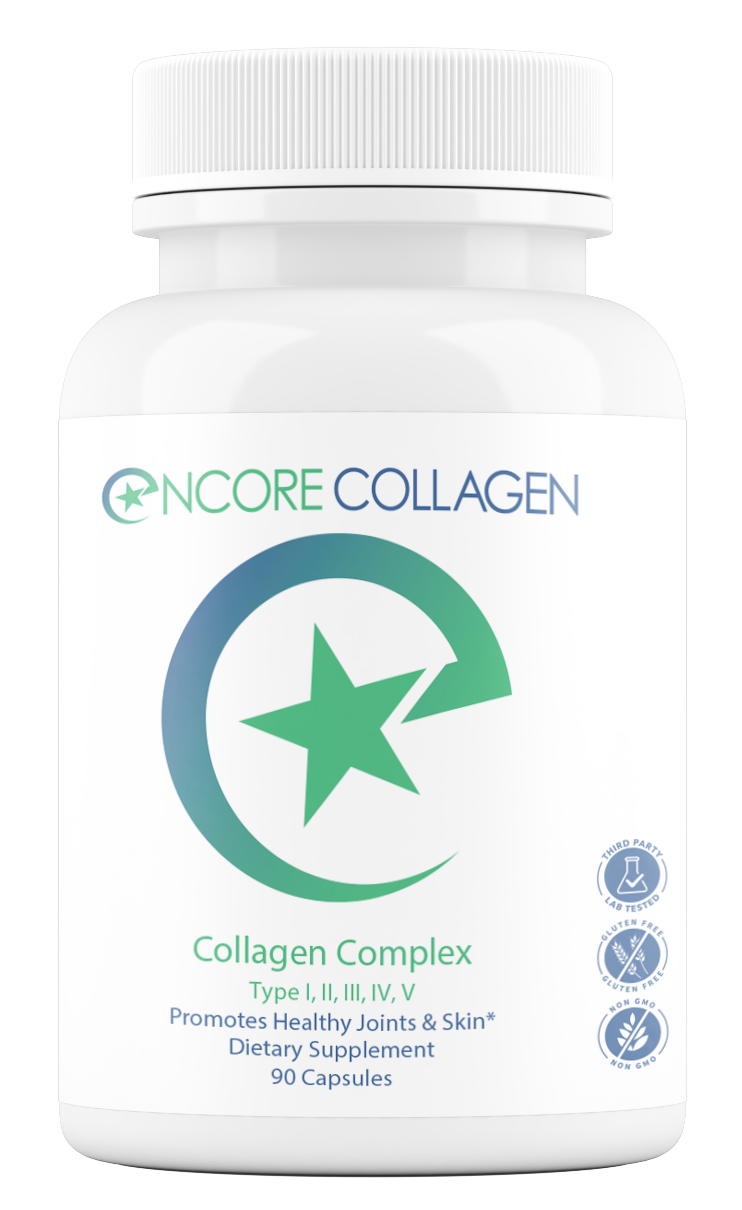
Encore Collagen Complex delivers 1,800mg of five-source collagen in three capsules - an easy evening habit to pair with your wind-down routine. It is built for skin and connective tissue support, not as a sleep aid.
Order Now →You could just buy a tub of pure glycine powder. Some people do. The reason to use hydrolyzed collagen instead comes down to the second thing your body is doing overnight: repair. Fibroblasts - the cells that make new collagen - need glycine, proline and hydroxyproline, plus vitamin C, to do that work, and deep sleep is when much of the body's growth-hormone-driven tissue repair takes place.
The trade-off is dose. Isolated glycine hits 3 grams in a teaspoon. Collagen gets there only at a large powder serving - but it brings the full set of collagen-building amino acids along with it.
This also answers a related question from the search data: should collagen be taken in the morning or evening? If your main goal is skin, joints, or hair, timing is not the hinge point — consistency over months is. If sleep quality is also a goal, evening is the more logical time to take it.
The strongest glycine-and-sleep data comes from a small set of controlled trials, most notably the work out of Japan with Yamadera and colleagues (published in Sleep and Biological Rhythms). Subjects with mild sleep complaints took 3 grams of glycine before bed; polysomnography showed they fell asleep faster and reached deep slow-wave sleep sooner, and they reported feeling better the next day. These are modest effects from small studies.
Trials of collagen itself for sleep are few and small, and their results are mixed. The case for collagen at night rests mostly on the glycine research - which is why dose matters.
What this does not prove is that collagen will fix insomnia, cure sleep apnea, or replace a dark cool bedroom. Sleep is a stack. Light exposure in the morning, caffeine cutoffs, consistent bedtime, screen hygiene — none of this becomes optional because you added a scoop of collagen. The scoop is additive, not substitutive.
In practice, the people who report the clearest difference after adding evening collagen are:
Adults over 40 whose collagen production has been dropping about 1% per year since their mid-twenties and who want connective tissue support anyway - evening is a natural time to take it.
People with "wired but tired" bedtime patterns — those whose sympathetic nervous system does not downshift easily. The inhibitory signal from glycine seems to help this group more than the general population.
People already dealing with low-grade joint discomfort who are not sleeping well because of it. Here the compound effect is bigger: the collagen supports the joint tissue over months, and the glycine supports the sleep that lets the tissue repair happen.
Encore Collagen Complex combines Types I through V from five sources at 1,800mg per serving. Three capsules with water in the evening supply the amino acid set your body uses to maintain connective tissue - an easy addition to a good sleep routine.
If you want to test this honestly, give it two weeks. A 12- to 15-gram serving of hydrolyzed collagen powder in warm water, 45 to 60 minutes before bed, no caffeine after noon, lights down 30 minutes before you intend to sleep. Keep a short sleep log — time to fall asleep, number of nighttime wake-ups, how rested you feel on waking. Fourteen nights is enough for the pattern to show if it is going to.
If you already take collagen in the morning for skin or joint reasons, you do not have to switch — split the dose. Half in the morning for the metabolic routine, half in the evening for the sleep assist. The amino acids are the same regardless of clock time.
Collagen and sleep is not a trendy marketing claim stapled onto a protein powder. It is a straightforward amino acid story that happens to be well-studied. Give your body the glycine on the schedule it wants it, and the rest tends to take care of itself.
If sleep is a priority, nighttime wins. Collagen is roughly 33% glycine, and 3 grams of glycine taken about an hour before bed has been shown in sleep-lab studies to reduce the time it takes to fall asleep and improve how rested people feel the next morning. Reaching that glycine dose takes a large serving of collagen powder, roughly 12 to 15 grams. If sleep is already solid, timing is less important and morning may be more convenient.
Glycine acts on NMDA receptors in the hypothalamus, which triggers a small drop in core body temperature. That temperature drop is one of the biological signals the brain uses to initiate sleep. Glycine also behaves as an inhibitory neurotransmitter in the central nervous system — effectively telling the brain to slow down. The combination quiets the system and makes it easier to fall and stay asleep.
Yes. Hydrolyzed collagen peptides are absorbed well with or without food. Taking a scoop in warm water about 45 to 60 minutes before bed gives the glycine time to reach the brain. It will not spike blood sugar and will not interfere with digestion the way a late meal might. Pair it with vitamin C earlier in the day for the synthesis side of the equation.
1,800mg of five-source collagen per serving. Third party tested. GMP certified. 90-day money-back guarantee.
Order the Collagen Complex →